Showing posts with label team. Show all posts

Tuesday, March 15, 2011

Jay Triano: Raps "seventh or eighth best shooting team in the NBA"

New readers, please check out the basics before leaving any comments.


According to Doug Smith of the Toronto Star, Jay Triano offered the following evaluation of the Raptors' shooting performance this season:
“Listen, we’re the seventh or eighth best shooting team in the NBA without being able to make a three-point shot. We have one game where we don’t really get it going from a variety of guys so let’s just (bleeping) relax a little bit.”
Really? Seventh or eighth? Other than that comment about not being able to make threes, I don't believe you have a handle on the stats, Mr. Triano. Thanks to dougstats, I have the shooting percentages of every team in the league for games played up to 03/12/11. Here's the table:

Thursday, December 16, 2010

Week 7 Raptors Auto WP

New readers, please read the basics before  leaving any comments.


Time for week 7 WP numbers, which are Powered by Nerd Numbers (full spreadsheet here):


Here are my thoughts:
  • Bargnani, Kleiza, and Barbosa have all had good games over the past week or so, and it's now showing in their WP48. Bargnani is up almost 0.035, Kleiza's up 0.040, and Barbosa's up around 0.040. Despite what many people think, I would love to see these trends continue.
  • Those three are still really unhelpful: only Barbosa is in the positive range (WP48 0.004), and only barely.
  • Weems and DeRozan remain mostly unchanged, and continue to offer very little as well.
  • Julian Wright has improved slightly.
  • Calderon and Evans haven't played, and so have remained stable.
  • Everyone else - Johnson, Bayless, Dorsey, and Davis - has declined. Other than Johnson, these players haven't played that many minutes, so the variation is not surprising. Johnson's been up and down all season long.
  • Even though his WP48 decreased, Bayless improved his AdjFG% by 5%. So why did his WP48 decrease? More minutes at PG (due to Calderon being injured) and fewer net possessions (his rebounding had been exceptional and was bound to regress).
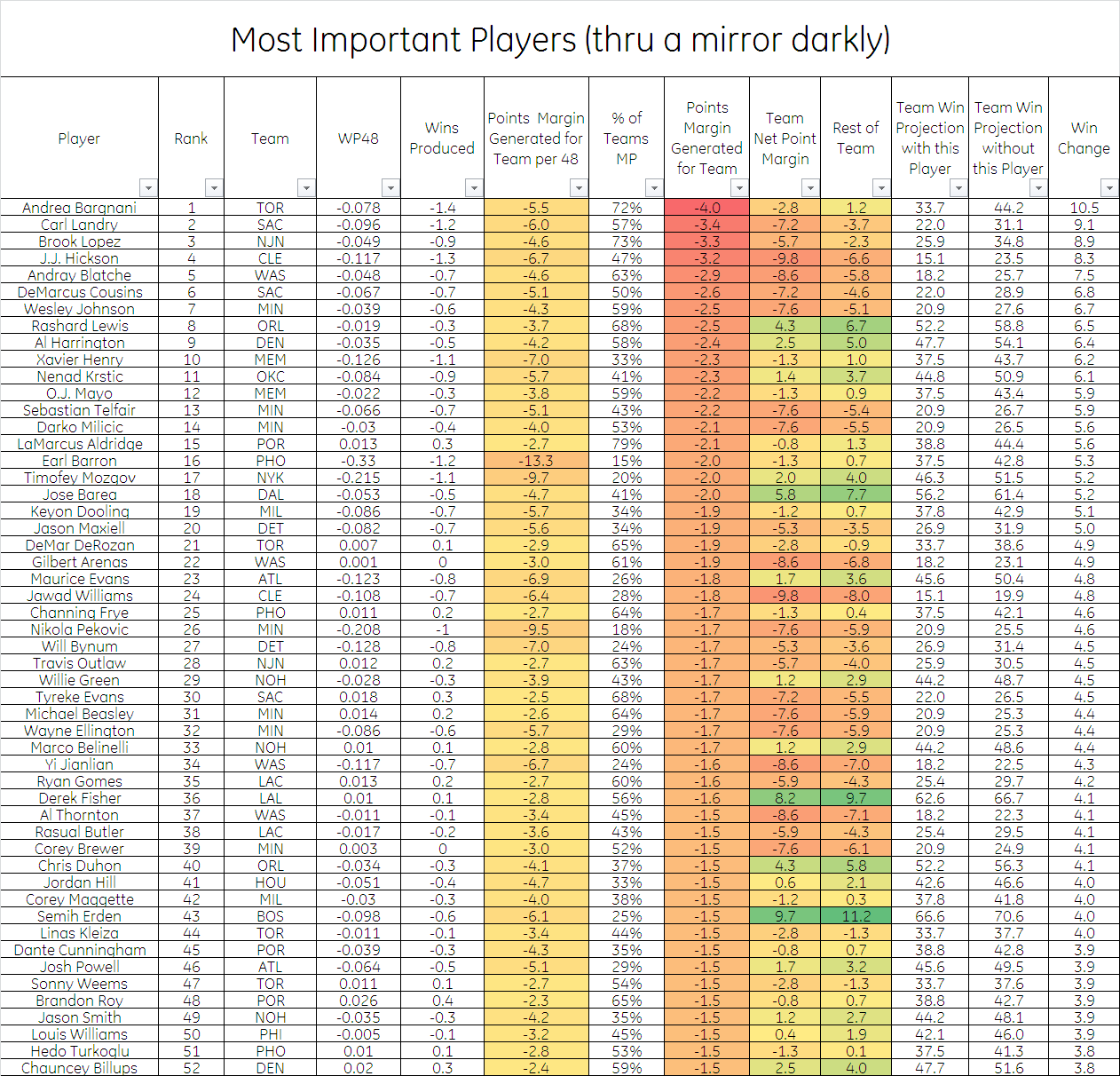
  • Reggie Evans and Amir Johnson are 27th and 37th, respectively, on Arturo's list of most important players
  • Bargnani, DeRozan, Kleiza, and Weems (1st, 21st, 44th, and 47th, respectively) are on Arturo's naughty list.
  • Maybe we'll just kick Barbosa out of that group for the time being and stick with the four horsemen again.
I'll try to keep posting regularly, but as the holidays get close, I have more and more things to do. Andres has kindly given me the WP numbers for the entire history of the Raptors franchise, so I'd like to do some work with that in the near future. I'm also still working on another Top 3 picks post. Hopefully these will be up shortly.

 - Devin.

    Monday, November 22, 2010

    Full TOR-NOH trade analysis

    New readers, please check out the basics before you leave any comments.


    It turns out that yes, the Raptors and Hornets did make a trade, and the details of the deal haven't changed since I posted my initial reactions. But I promised I would come up with some fancy graphs, so here is one:


    Now everything I mentioned earlier becomes that much clearer. Over the past three seasons, the players Toronto had before the trade were better on a per-minute basis (WP48 of 0.077) and in terms of total wins (14.5) than the New Orleans players (WP48 of 0.051 and 9.2 wins produced). This year, the former Raptors have also been more productive on a per-minute basis (WP48 of 0.073 vs -0.046) and in terms of wins (0.8 vs -0.2). The Raptors take on $5.5 million in extra salary this season, but manage to save about $3.6 million over all of the years after that. Additionally, the Raptors seem to have spent about $2.3 million of the Bosh trade exception (as far as I can gather). So, to recap, the Raptors:
    • traded for players who have been less productive in the past
    • traded for players who have been less productive so far this season
    • traded for players who are likely to be less productive in the future
    • take on an extra $5.5 million in salary this season
    • save $3.6 million over the years after this season
    • spent $2.3 million of the TPE
    • opened up a roster spot
    No, this is not a good deal. If the trade was "made with the future in mind", whoever's responsible for approving the trade either wants the Raps to do worse as an organization or is incompetent (we know where I stand on that issue). It doesn't improve the team on the court in the short term or long term, and financially, it hurts the team more in the short term than it helps in the long term. At least Bryan Colangelo is up front about the team being worse in the short term:
    "whether or not we win games is really not the true issue right now, it's how much we're growing as an organization, how much these young kids are coming along." 
    Unfortunately for the Raptors, Bayless probably won't become a useful player, and everyone knows what BC has done with lots of cap space in the past (see Turkoglu, Hedo).

     - Devin

    Saturday, November 20, 2010

    Potential Raptor trade?

    New readers, please check out the basics before leaving any comments.


    According to ESPN, the Raptors and Hornets have agreed to a five player swap. Leaving Toronto are Jarrett Jack, David Andersen, and Marcus Banks. Arriving are Peja Stojakovic and Jerryd Bayless.

    Now, this is merely a reported deal - nothing has been finalized. I'll provide my intial reactions now, and if the deal changes between now and when it becomes finalized, I'll change my analysis accordingly.


    This trade would accomplish two major things for the Raptors: first of all, it clears salary. Peja has one year remaining on his contract, which is somewhere north of $14.25 million. The second thing it does is create a roster space, which the Raptors will presumably use to obtain a centre (hopefully Erick Dampier), given that there is only one "centre" on the roster at the moment (because Andersen will be traded away and Solomon Alabi has been assigned to the D-League). It also nets the Raps a young, cheap player in Jerryd Bayless.

    But I'm not really impressed with this deal. If the Raptors are interested in shedding salary, Jack, Andersen, and Banks are not the best players to get rid of. Banks's deal is expiring at the end of this season, so including him doesn't really accomplish anything. Jack's deal is very reasonable - $4.86 million this season, $5.22 million next season, and $5.58 million the season after that - given that he produced 6.9 wins last year (second most on the team behind Chris Bosh). Even though he's been injured, he hasn't been playing as well this season - which isn't entirely surprising (last year was a career year for Jack). But even if Jack goes back to being as productive as he was in 2008-09, he'd still be worth the money. Andersen didn't play well at all during his rookie season last year, but through preseason and the season so far he's been far more productive than Andrea Bargnani, who the Raptors are paying $50 million over the next five years. Andersen is getting $2.5 million this year, with a team option for $2.7 million next year, which is relatively cheap. No, if the Raptors were interested in shedding salary, they would've been better to trade away Bargnani, Calderon, or Barbosa.

    And what about the players they will be getting back, Jerryd Bayless and the corpse formerly known as Peja? These days, the only thing attractive about Peja as a player is the fact that his massive contract is expiring at the end of the season. The last time Peja produced at an above average level (WP48 of 0.100 or above) was the 2007-08 season, when he had a WP48 of 0.102 and 5.8 wins in 2711 minutes. In 2006-07, his WP48 was negative, and in 2005-06, his WP48 was 0.148. So really, we're not talking about someone who should be expected to make any sort of difference on the court...although, after 76 minutes this season, his WP48 is 0.184 :)

    The allure of Jerryd Bayless is probably what sold this deal for the Raptors. Bayless is a young player who was taken by Indiana with the 11th pick of the 2008 draft, and then, along with Ike Diogu, traded to the Trailblazers for Josh McRoberts, Brandon Rush, and...Jarrett Jack. That's good, right? The Raptors are stockpiling cheap young players like I suggested! Well yes, except that, when you go after cheap young players, you are still supposed to go after good cheap young players. In his rookie season, Bayless had a WP48 of  -0.099. In his second season, Bayless posted a WP48 of 0.025. This year, his WP48 is only -0.149 after 133 minutes of playing time. So, in 1959 career minutes, he has produced -1.1 wins with a WP48 of -0.027.

    Jerryd Bayless can't be included in a multi-player deal because he was just traded to the Hornets; the two teams will actually have to make two separate trades in order for this transaction to adhere to league rules. To top it all off, rumour has it that the Raptors might even be using part of the Chris Bosh trade exception in this deal. If so, that just makes it that much worse. I'm sure the Raptors could've done better than this trade. Even if this trade opens up a roster spot for Erick Dampier and they pair Stojakovic's expiring deal with the Bosh trade exception to land a big-name player, they could've done better than this.


    For the Hornets, this deal was a no-brainer. They get a very useful player in Jack, an okay (for now) backup big man (with what amounts to an expiring deal) in Andersen, and an expiring contract in Banks. All they had to do was give up Peja's contract and Bayless?!?!?!? This trade makes them even better in the short term, and doesn't have much of an impact on the books (short term or long term). The only negative thing about it is that perhaps they could have nabbed a big-name player with Peja's contract, but that's only a hypothetical.


    If this trade becomes official, I'll put up a new post with lots of fancy tables and the final analysis. Stay tuned.

     - Devin

    Tuesday, November 16, 2010

    Week 3 WP Numbers

    Since it's Tuesday, it's time for another look at Andres' automated WP numbers (spreadsheet here):


    Here are my thoughts:

    • Not really too much has changed; Evans and Johnson are still playing really well; Jack, Calderon, and Andersen are playing okay; and the four horsemen are still stinking up the joint (although DeRozan somewhat less so)
    • But Weems has improved and - in limited minutes - so has Dorsey. Wright has regressed in limited minutes
    • None of that is surprising, given past histories and preseason numbers
    • One thing the take into account: using the automated positions, Barbosa is listed as a PG - which makes him look worse than he really is - and has Jack playing more time at SG - which makes him look better than he is. Kleiza is also listed as a SG for part of his minutes, which (very scarily) means he's actually been worse than what we see here
    • At -0.9 wins produced Bargnani "leads" the league. Just thought I'd put that out there
    • At -0.6 wins produced, Kleiza is close behind Bargnani at "7th" (and remember, he's actually played even worse than those numbers indicate)
    • Reggie is now 30th in total wins produced, right around Kobe Bryant (27th)
    • Raps have played a little bit better than their record suggests, with 3.6 wins produced and only a 2-8 record to show for it
    • The bigs who should be getting playing time: Evans, Johnson, Dorsey, and Andersen
    • The guards/smalls who should be getting playing time: Jack, Calderon, Weems, and...uhhhh...either Wright (not really a small, but we're dealing with lemons here) or DeRozan

    Coming up soon: team stats for week three.

     - Devin

    Thursday, November 11, 2010

    Team Stats for 2010-11

    New readers, please check out the basics before you leave any comments.


    Thanks to dougstats (and of course Andres) I have been able to compile advanced stats for every team in the league this season. Along with the Raptor individual player stats, I will continue to update this on a weekly basis. Because I'm having trouble getting Google gadgets to work, here is the non-sortable spreadsheet (spreadsheet here):


    Here are my thoughts about the how the Raptors compare to the rest of the league so far:
    • The team is 9th in FGA, but 27th in AdjFG%. The Raptors need to take better shots
    • More specifically, better 3pt shots, as they are 29th in 3pt% - although their 2P% (24th) isn't so hot either
    • At least they are shooting better than the T-Wolves (2nd in FGA, 30th in AdjFG%)!
    • I'm happy to report that the Raptors are 13th in rebounding with 8.3 (per player per 48 minutes, or ppp48), just behind the league average of 8.4
    • Doing a good job of getting offensive rebounds (3rd overall) in particular...actually pretty weak at defensive rebounding (27th). On the offensive side, I'd attribute this to a combination of poor FG%, Reggie Evans, and Amir Johnson; on the defensive side, I'd attribute this to poor FG% defense
    • They are also 9th in steals...but unfortunately 7th in TOs, leaving them at 20th for Net Possessions
    • Interestingly - despite their reputation as "Phoenix North" - the Raps are only 28th in 3Pa/FGa
    • They also do a good job on free throws too, good enough for 8th in the league, 8th in FT%, and 12th in FTa/FGa
    • Assists: 24th, blocks: 27th, and fouls: 9th. None of these rankings are positive
    • Put it all together, and the Raptors are 25th in WP48 - 12th place in the Eastern Conference standings

    I'd like to say a few things to the commenters on my recent posts: thank you for reading, and thank you for leaving some comments! Kudos to most of you for being respectful and adding to the discussions. Unfortunately, I'm not necessarily going to be able to respond to all the comments very promptly over the next few days, but that doesn't mean that I didn't read what you wrote.


    Coming up next: a post on whether or not top 3 draft picks lead to NBA championships.


     - Devin

      Tuesday, November 9, 2010

      Week 2 WP Numbers

      New readers, please check out the basics before you leave any comments.


      Andres Alvarez has been updating the automated WP site regularly, so it's time for week two of the Auto WP numbers (spreadsheet here):


      From now on, this spreadsheet will be updated automatically, so in the future, this entry will have current data (ie: my comments in this post might not make sense if you view this post next week)

      Here are my thoughts for the season so far:
      • Reggie Evans has still been playing rather well, but (as I predicted) not quite as well as he had been playing. He still leads the Raptors with 1.4 wins
      • Jarrett Jack and Amir Johnson are next with 0.7 wins apiece. Johnson has been playing at a more productive rate, but he still hasn't been getting much playing time behind Evans
      • Calderon, Andersen, and Weems are in the next tier with 0.4, 0.3, and 0.3 wins, respectively
      • Banks, Dorsey, and Wright are all around 0.1 in limited minutes
      • And then we have the Four Horsemen - DeRozan, Barbosa, Kleiza, and Bargnani - all producing at negative levels (-0.2, -0.2, -0.4, -0.5, respectively)
      • Each of these players are in the team's top five for shot attempts. Unfortunately none has managed to score an average amount of points per shot
      • Also unfortunate is that three of the Four Horsemen are in the Raptors' top four for minutes played
      • Reggie's shooting is mind-blowingly bad - but the guy rebounds like a madman and that makes up for it (and then some)
      • Johnson has foul trouble - big surprise. But as I've said before, all he has to do is be able to play 30 minutes; Johnson could still play just over 31.5 minutes a game at his current foul rate of 9.1 per 48min
      • David Andersen is still the rich man's Bargnani. Based on his play so far, he should probably be the Raptors' starting centre
      • Calderon's been productive without shooting well - hopefully he'll regress back to his normal shooting and see a jump in productivity
      • Kleiza has really fallen off what he was doing during preseason play
      And let's check up on how Bargnavans is doing:


      Oh, not so good. Who could've predicted that? Now that Reggie has fallen back down to earth and Bargnani is starting to work his "magic", the two don't look nearly as good together. The problem lies with Bargnani, of course, but don't tell that the kool-aid drinkers (unless you are a masochist).


      Overall, there haven't really been many surprises for the Raptors so far - if they continue to play like this, they should finish the season with around 27 wins, which is what many people predicted before the start of the season.

      In the next few days I'll be posting team data for every team in the league and seeing how the Raptors compare in various categories. But before I sign off, I'd like to say one thing: the state of basketball coverage is atrocious here in Victoria. I haven't been able to catch a single game on basic cable since the start of the season, and weeks can go by between showings. I blame this on the fact that the Raptors always put their games on stupid specialty channels like TSN2 or Sportsnet One. As the only Canadian team in the entire league, the Raptors should really focus on two things: 1) putting a better product on the court and 2) building their fanbase. Putting more games on basic cable across the country would go a long way towards the latter, although unfortunately I suspect that lack of success with regards to the former is to blame.

       - Devin

      Wednesday, November 3, 2010

      AGS for Front Offices Audit: Toronto Raptors Part 3

      For you new readers out there, make sure you know about the basics before you leave a silly anonymous comment.


      Continuing with the third part of the front office audit series (please see part 1 and part 2), I'll examine the last three components and offer some suggestions on how to turn the franchise around.


      5) If you are going to the free agent market then look for low-priced underrated players.

      Colangelo has actually done a pretty good job on this one historically. The Raptors have signed Jose Calderon (Rob Babcock's work, actually), Anthony Parker, Jorge Garbojosa, and Linas Kleiza (all at cheap salaries) from Europe. David Berri, founder of the Wages of Wins Network and creator of the Wins Produced metric, called it Colangelo's "third way" (in addition to drafting and NBA free agents/trades). He also found the undrafted, cheap, and very productive Jamario Moon. He recently re-signed Amir Johnson to a reasonable contract. But at the same time, Colangelo has also signed Hedo Turkoglu to a terrible free agent deal, given Bargnani a ridiculously huge (and long) extension,  traded for the Player Formerly Known as Jermaine O'Neal, and actually gave Jason Kapono a positive amount of money in his contract (rather than asking Kapono to pay him to stay on the team, which is what he'd have done if this was a rational world). So he's done very well on the "small" deals, but very poorly on the "big" deals. In this case, the good outweighs the bad, but the bad has been so bad that I can only give him partial marks on this one.


      6) For the playoffs it is more important to have stars than average players. If given the opportunity trade for stars even if it means losing a few slightly above average players.

      Playoffs? You're talking about playoffs?!?!? [that's the first and probably the only time I will reference North American Football on this blog] Well, in terms of stars, the Raptors haven't had much luck. Damon Stoudemire and Vince Carter asked to be traded. Tracy McGrady, Shawn Marion, and Chris Bosh left as free agents. Good players like Jerome Williams and Marcus Camby were stupidly traded away. Older but good players like Hakeem Olajuwon, Charles Oakley, and Mark Jackson faded and were either traded away or decided to retire. The Raptors have failed in this area completely.


      7) Target good big men (Power Forwards – Centers) and ball handlers (Point Guards).

      The Raptors have targeted big men in draft after draft - but other than Bosh, their decisions have been terribly poor. They have had good point guards fall into their hands, only to watch them struggle with injuries (Alvin Williams, Calderon) or suffer from age-related decline (Mark Jackson). In one instance, Colangelo actually traded a big (Charlie Villanueva) for a small (T.J. Ford), something that is a "no-no" according to traditional basketball wisdom; given that Ford was productive and Villanueva was not, it was actually a good move. I'm going to give them an A for effort, but an F for their execution.


      Summary:
      Five failures and two partial marks out of seven


      Verdict:
      Do not pass go, do not collect $200.


      Future Direction?


      Let me start by stating the obvious: hire a GM who knows what they're doing (allow me to suggest a Mr. Galletti). That means that the Raptors should not renew Colangelo's contract once it expires at the end of this season (or fire him sometime during the season), even though they are probably going to ignore that advice.

      The next step is figuring out which contracts the Raptors should keep on the books. Most of the players on the team are signed to relatively cheap contracts, but Calderon, Bargnani, and Barbosa have the biggest deals. Bargnani needs to be traded. Barbosa is overvalued and it shouldn't be hard to trade him to a contender or pseudo-contender. Calderon is the interesting case. His history suggests that he is a good player, but he has been declining, his recent play has been poor, and his contract is pretty hefty. I'd keep him for one more season and see how he fares; if he does poorly, he'd be gone before the start of next season. In each of these cases, I would only make trades that would net me at least one (hopefully more) of the following: young players on rookie contracts, players with expiring deals, stars/superstar players (determined by Wins Produced), and draft picks.

      The next issue is the Bosh trade exception: it needs to be used. If I had to include it in a package with one of the above players, I would. But preferably I'd used it to acquire a superstar player. I'd go after every star/superstar that I could get (your Wades, Lebrons, Howards, Durants, Rondos and Pauls) but most of those players aren't on the market, so I'd target up-and-coming stars like Westbrook, Noah, Batum, Love, and the like. I'd also look at non-star players if I couldn't do any better.

      Once that was done, I'd have a cheap, young, and better team. I'd make sure to continue to flip scorers for draft picks and to use WS40 to determine which players I should draft (or I could just ask Mr. Galletti). The only time I would trade away draft picks is if I could obtain a superstar calibre player in return.

      Of the cheaper players on the roster, I'd trade away DeRozan after this season if he maintains his current trajectory. I'd try to include Marcus Banks in deals, but if I couldn't find a use for him I'd be fine with letting his contract come off the books. I'd resign Reggie Evans and Joey Dorsey to really cheap contracts as long as they produce like they have in the past, but I'd avoid long-term deals. Julian Wright and Sonny Weems are quite replaceable, so I'd probably shop around for better players on the free agent market, or use the "third way" and find hidden gems in Europe.

      I guarantee that this plan would have better success than whatever Colangelo is doing right now. Such a plan would likely net a playoff berth in the next two seasons, followed by advancing to the second round in the following two years after that. And if the Raptors hired either Arturo, myself, or any of the other Wages of Wins Network analysts, I doubt that they would regret it.

       - Devin

      Week 1 WP Numbers

      For you new readers out there, make sure you know about the basics before you leave a cowardly, anonymous comment that insults my intelligence, while offering no argument in support of that position.

      Here are the automated WP numbers from the Raptors first three games (or view as a spreadsheet here):


      My thoughts for the first week of the season:
      • Wow. Reggie Evans is actually getting playing time! What we saw in preseason wasn't just experimentation
      • Evans is killing it on the boards - 25 reb/48 - and it's boosting up his WP48. He's 9th in the league in total wins right now!
      • And yet...his scoring is total garbage. Good thing he isn't shooting at all
      • Bargnani hasn't been terrible so far; bad, but not terrible
      • Sure, he's scored 33 1/3 points per 48 on 1.08 PPS...but your starting centre is grabbing only 4.3 Reb per 48 (eeeewww)
      • Overall, Calderon hasn't played well yet either
      • After being a very players during the preseason, both Kleiza and Jack haven't played as well. Blame Jack's performance on injuries, Kleiza's on...poor rebounding and bad TO numbers
      • DeRozan has played well - good rebounding numbers so far
      • Andersen continues to be the rich man's Bargnani, and continues to shoot better and rebound better than the Italian
      • Amir Johnson played three games without missing a FG!
      • But he hasn't played very much - partly fouls, partly coaching. With Evans playing so well, what's the rotation going to be like when Davis gets back?
      • Weems and Barbosa have to shoot better if they aren't going to produce in other areas
      • After the promising victory over the Varejao-less Cavs, what a bad finish to the Sacramento game

      Also, I'd like to address something: Bargnani is not a SF. He plays centre defensively most of the time, and if you squint really hard, you can pretend that he's a 3 on offense. But if you average those two aspects of the game, you get (at best) someone who is strictly a PF. The good thing is that Evans and Bargnani complement each other well; Evans can't (and doesn't) shoot, and Bargnani can't (and doesn't) rebound.  If you add the two together, you get two frontcourt players with the following per 48min averages:


      It's important to remember two things, however: Evans should get all the credit for gaining the extra possessions (rebounds), and Evans will fall back to earth in a couple of games, making this average far less appealing in the near future. I'll be keeping track of the Bargnavans factor throughout the season if this keeps up.

       - Devin

      Sunday, October 31, 2010

      AG Standards for Front Offices Audit: Toronto Raptors (Draft History II)

      This article uses the Wins Produced metric to discuss the productivity of NBA players. This metric is based on box score statistics that are adjusted for other factors including pace, position and team. A general scale is given for these, and links to advanced explanations are listed at the bottom of the page.

      Wins Produced per 48 Minutes (WP48) – The number of wins a player produces in 48 minutes of play. 0.100 is average and 0.250 is considered the “superstar threshold”. A player a WP48 of 0.000 produces no wins, and any player with a negative WP48 produces a negative number a wins (or, if you prefer, a positive number of losses)

      For more information on the terms used in this post, please consult the Glossary of Terms.


      Last time we looked at the last ten years of Toronto's draft history. The general conclusion? The Raptors are really bad at drafting productive players (or, if you want to put an optimistic spin on it, the Raptors are excellent at drafting unproductive players). But, as bad as they were, maybe some of those draft choices were the best available options? Let's take an individual look at each draft pick and see if the Raptors could have gotten anything better than they did (you might want to follow along with this spreadsheet).


      • 2000: #21 Morris Peterson; #56 DeeAndre Hulett 

      As a Raptor fan, I gotta love the man. But looking at the numbers, Mo Pete wasn't so good in his first four seasons; he only managed a WP48 of 0.050. At the 21st pick, you would expect there to be some more palatable options than that, but was that the case? While there were 7 players with higher WP48s selected after him, the only truly useful players available were Michael Redd and Eduardo Najera. Overall, Mo Pete wasn't too bad of a pick.

      DeeAndre Hulett never played a minute in the NBA, and neither did most of the players selected after him. While Jason Hart eventually played 5289 NBA minutes, he didn't play enough in his first four years to qualify. I'd give the Raptors a pass on this pick.


      • 2001: #17 Michael Bradley; #46 (traded) 

      Michael Bradley was actually a pretty good player in limited minutes. Despite that, he never made much of an impact on the NBA, and after the Raptors cut him in 2004, his NBA career was pretty much over. Instead of Bradley, the Raps could've had Mehmet Okur, Jamaal Tinsley, or Samuel Dalembert. The Raptors didn't do too badly with Bradley - now if only they had had the intelligence to play him more minutes.

      The 46th pick was traded. Which was fine, because that year there were no useful players available at that number. So far the Raptors have been pretty good.


      • 2002: #20 (traded); #27 Chris Jefferies; #42 (traded) 

      And so begins the trading of useful draft picks. Kareem Rush was not a productive player - and Chris Jefferies didn't last long enough for us to find out how good he was. Trading down from #20 to #27, the Raptors missed out on the opportunity to draft Tayshaun Prince. Useful players available at #27 included Carlos Boozer, Dan Gadzuric, Luis Scola, and Matt Barnes. Given that the other two players involved in the exchange of these draft picks were Lindsey Hunter and Tracy Murray, I have no choice but to fail this draft decision. Drafting Carlos Boozer or Luis Scola would've been much better than Jefferies.

      At #42, Scola and Barnes were still on the board. Yes, the Raptors could've picked up Boozer and Scola in the same draft if they knew what they were doing. And that is why you don't trade away your second round picks: when you hit with them, they have the potential to turn your franchise around.


      • 2003: #4 Chris Bosh; #52 Remon Van der Hare 

      Chris Bosh was a very good fourth pick - accordingly, Arturo ranks him 144 out of 980 draftees. But there were three players available who were even better than Bosh: Wade, Josh Howard, and Luke Walton. Now, keeping in mind that this ranking only considers the first four years, the only player I would think about drafting instead of Bosh would be (of course) Wade. So the Raptors did very well on this one.

      Van der Hare never played in the NBA - and no one else drafted after him was useful. Looks like 2003 was a good drafting year.


      • 2004: #8 Rafael Araujo; #39 (traded); #47 Pape Sow 

      Ah, the first monumental Raptor bust of the 21st century! Araujo was such a bad pick that he only managed to last 1585 career minutes. In those minutes, he was very bad (WP48 lower than -0.07). Who could the Raptors have chosen instead? Oh, only Andris Biedrins, Andre Iguodala, Al Jefferson, Kevin Martin, Anderson Varejao, Trevor Ariza, Dorell Wright, Josh Smith, Delonte West, Chris Duhon, Tony Allen, and Jameer Nelson - all above-average (WP48 greater than 0.100) players. It's funny, because the recent development of Bargnani had almost made me forget about Hoffa.

      The 39th pick could have been useful - Trevor Ariza and Bernard Robinson were both available. Robinson wasn't all that good, but Ariza certainly was.

      Ah, good old Pape. Well, he didn't play enough minutes to get ranked, and he wasn't that productive...but there was nothing after him. Hmmm. Maybe Toronto should have just taken Ariza at the 39th instead of trading down...but they only missed one really decent player, so you can't hold it against them too much. Overall though, 2004 was a bad year.


      • 2005: #7 Charlie Villanueva; #11 (traded); #16 Joey Graham; #38 (traded); #41 Roko Ukic; #58 Uros Slokar 

      Busy draft year for the Raptors - let's start with the pick that had so many "experts" laughing: Villanueva. He actually wasn't that bad of a player - he managed a WP48 of 0.072 - and, as a scorer, was overrated, but the biggest problem with picking Villanueva so low was that...there were so many better players available. How many? Only David Lee, Marcin Gortat, Amir Johnson, Andrew Bynum, Luther Head, Danny Granger, Travis Diener, Jason Maxiell, Monta Ellis, Jarrett Jack, Ersan Ilyasova, and Ronny Turiaf. The Raptors could've at least chosen Granger there instead. This pick gets a D.

      With Graham, you were never sure if you were getting "good Joey", the player who rebounded well and attacked the basket for easy shots, or "bad Joey", the player who hoisted up silly jumpers and didn't do much else (maybe the twins were playing tricks on us all?). Over his first four years his WP48 was 0.056. Again, instead of Graham, the Raptors could've had David Lee, Marcin Gortat, Amir Johnson, Luther Head, Danny Granger, Travis Diener, Jason Maxiell, Monta Ellis, Jarrett Jack, Ersan Ilyasova, or Ronny Turiaf. This pick gets a D minus.

      Instead of seldomly played Roko Ukic, the Raptors could have had Gortat or Amir Johnson. But Ukic is exactly the kind of pick you want to make in the second round: high risk, high reward. All things considered, not a terrible choice.

      Uros Slokar: another high risk, high reward pick. This time it didn't pan out, but again, at least Toronto went for it. There were no useful players selected after Slokar either, so this was an okay pick.


      • 2006: #1 Andrea Bargnani; #20 (traded); #35 P.J. Tucker; #56 Edin Bavcic 

      Everyone should know by now how badly the Raptors did by choosing Bargnani; I've talked about it several times before. In fact, if you've read those posts you'll know that Bargnani is ranked 970/980 draftees on Arturo's list. Instead of Bargnani, the Raptors could have chosen: Rajon Rondo, Renaldo Balkman, Brandon Roy, Paul Millsap, Ronnie Brewer, Leon Powe, Josh Boone, Kyle Lowry, Thabo Sefolosha, Tyrus Thomas, or Shelden Williams. This pick is an F.

      Had the Raptors not traded #20, they could've had Rondo, Balkman, Millsap, Powe, Boone, or Lowry. Instead, the 20th pick was used to sweeten up the Jalen Rose trade, which was simply a correction of a previous mistake...and the resulting cap room led to future mistakes. Dumb.

      P.J. Tucker didn't get much of a chance to play in the NBA, but when he did play, he showed promise. And after he left for overseas, he actually managed to achieve some measure of success. So the Raptors took exactly the kind of player they were supposed to, only to cut the guy in favour of Luke Jackson.

      As Arturo would say

      Edin Bavcic didn't play - and there was nobody useful picked after him - but again, at least the Raptors were looking for hidden gems


      • 2007: #22 (traded); #52 (traded) 

      Ah, the year of no picks. Why no picks? Because - years before Colangelo - they needed to get rid of Yogi Stewart and wanted to acquire Lamond Murray and John Wallace. Who could they have picked at #22? Rudy Fernandez, Carl Landry, Marc Gasol, Ramon Sessions, and Jared Dudley. At #52, they still could have had Sessions. Lesson? Don't trade away your picks.


      • 2008: #17 (traded); #41 Nathan Jawai; #45 (traded) 

      Really? T.J. Ford, Rasho Nesterovic, and the 17th pick for Jermaine O'Neal? The only saving grace of the trade was the cap room that it created, and BC did not use it wisely. The returns are still pretty early, but at #17, the Raptors could have had Luc Mbah a Moute, Serge Ibaka, DeAndre Jordan, Bill Walker, J.J. Hickson, Mario Chalmers, Courtney Lee, Goran Dragic, Ryan Anderson, and Sonny Weems. I'd take any of those players over Jermaine O'Neal, and I'd have been happy to keep T.J. Ford for a bit longer, thank you very much.

      Instead of Jawai, Toronto could have had Walker or Dragic. Not too bad, and Jawai was an okay gamble. Those same two players were still available at #45 as well.


      • 2009: #9 DeMar DeRozan; #39 (traded); #51 (traded) 

      Another lottery pick, another poor choice. DeRozan didn't have good numbers coming out of college, and his first year wasn't very good (nor was his preseason this year). DeRozan is shaping up to be your classic Raptors lottery pick bust. Who could the Raptors have had instead? DeJuan Blair, Ty Lawson, Jon Brockman, Chase Budinger, Rodrigue Beaubois, Jonas Jerebko, Austin Daye, Jeff Pendergraph, Taj Gibson, Omri Casspi, or Darren Collison - just to name the above average players. It'll be a few more years before we can fully evaluate this draft class, but it's looking very likely that the Raptors made another poor choice.

      Picks #39 and #51 were traded. Remember what I said about trading draft picks? Imagine Jerebko, Budinger, Marcus Thornton, or A.J. Price on the team. At least the Raptors got Carlos Delfino out of it...er, I mean, Amir Johnson (not bad, actually, although I would've preferred to have kept Delfino).

      • 2010: #13 Ed Davis; #42 (traded), #50 Solomon Alabi 

      Ed Davis seems like he's going to be a very good NBA player, and eventually we will get to see him in action. Based on nothing other than college numbers, it looks as if the Raptors made good pick. Although it must be said that the fact that there were 12 teams drafting ahead of them was probably a big factor in them choosing Davis.

      In dropping down from #42 to #50, the Raptors may have missed out on a man with a sexy name, Devin Ebanks, and a man with a humourously erroneous name, Tiny Gallon. I'm not so sure that Alabi was a high risk/high reward player...high risk, certainly, but given that he played in the NCAA and didn't post good numbers, it's not likely that he will turn out to be too productive.


      Draft Verdict?

      In the last ten years, the Raptors have hit on a draft pick only once (maybe twice if Ed Davis turns out be as good as we think). That is a terrible, putrid rate. Some of the middling picks (late teens to early 30s) were okay, but the Raptors ended up cutting/trading away the draftee too early. Some of their second round picks were at least adventurous, but none of them succeeded. Any time the Raptors get into the lottery, there is a very good chance that they will select someone who not is very productive. To make matters even worse, Toronto has also traded away a rather large number of picks and hasn't made many trades to acquire any back - except for the occasional forced trade, such as the trades involving Carter and Bosh. So really...you can't blame good players for avoiding Toronto.

      Next week I'll post Week 1 team stats (as reader Mattt points out, the Raptors are at 0.500 at the moment!), as well as the final part of this AGS front office audit and suggestions for turning the franchise around.

       - Devin

      Thursday, October 28, 2010

      Updates: Season and Team Projections

      This article uses the Wins Produced metric to discuss the productivity of NBA players. This metric is based on box score statistics that are adjusted for other factors including pace, position and team. A general scale is given for these, and links to advanced explanations are listed at the bottom of the page.

      Wins Produced per 48 Minutes (WP48) – The number of wins a player produces in 48 minutes of play. 0.100 is average and 0.250 is considered the “superstar threshold”. A player a WP48 of 0.000 produces no wins, and any player with a negative WP48 produces a negative number a wins (or, if you prefer, a positive number of losses)


      For more information on the terms used in this post, please consult the Glossary of Terms.


      I have made a few slight changes to both the season predictions and the Raptors prediction; in the case of the Raptors, it looks like Jay Triano is going to play Reggie Evans as much as he did in the preseason, and, due to his struggles, Calderon will be playing less. I adjusted the numbers accordingly and the Raptors improve by...less than one win (although it rounds up). With my season numbers, I knocked off 8 wins to make sure all the league wins added up to 1230. Previously, I was happy with close enough, but...might as well make it more realistic. While all of the previous wins were calculated using the numbers, this knocking off business was done rather subjectively. So here are the last numbers:


      Eastern Conference:

      1. Miami Heat (65-17)
      2. Chicago Bulls (55-27)
      3. Orlando Magic (54-28)
      4. Boston Celtics (53-29)
      5. Atlanta Hawks (46-36) 
      6. Milwaukee Bucks (44-38)
      7. New Jersey Nets (41-41)
      8. Cleveland Cavaliers (39-43)
      9. New York Knicks (38-44)
      10. Charlotte Bobcats (33-49)
      11. Detroit Pistons (29-53)
      12. Toronto Raptors (28-54)
      13. Indiana Pacers (26-56)
      14. Philadelphia 76ers (19-63)
      15. Washington Wizards (10-72)

      Western Conference:
      1. Portland Trailblazers (61-21)
      2. San Antonio Spurs (58-24)
      3. Los Angeles Lakers (56-26)
      4. Golden State Warriors (48-34)
      5. Dallas Mavericks (47-35)
      6. Denver Nuggets (45-37)
      7. Oklahoma City Thunder (44-38)
      8. Phoenix Suns (44-38)
      9. Sacramento Kings (43-39)
      10. New Orleans Hornets (43-39)
      11. Houston Rockets (42-40)
      12. Utah Jazz (42-40)
      13. Memphis Grizzlies (29-53)
      14. Minnesota Timberwolves (26-56)
      15. Los Angeles Clippers (22-60)

      The spreadsheet with the updated projections for the Raptors has been automatically updated, but I'll repost it:


      In addition to continuing the front office audit, I'll be doing weekly posts on the Raptors' performance during the season using Andres' automated wins produced numbers.

       - Devin

      Wednesday, October 27, 2010

      AGS for Front Offices Audit: Toronto Raptors (Part 1:Draft history)

      This article uses the Wins Produced metric to discuss the productivity of NBA players. This metric is based on box score statistics that are adjusted for other factors including pace, position and team. A general scale is given for these, and links to advanced explanations are listed at the bottom of the page.

      Wins Produced per 48 Minutes (WP48) – The number of wins a player produces in 48 minutes of play. 0.100 is average and 0.250 is considered the “superstar threshold”. A player a WP48 of 0.000 produces no wins, and any player with a negative WP48 produces a negative number a wins (or, if you prefer, a positive number of losses)


      For more information on the terms used in this post, please consult the Glossary of Terms.
       

      As promised, let's take a look at the Raptors' management plan. To start, I have been analyzing the organizational philosophy of the Raptors, and after hours of work, I have come up with an image that summarizes my findings:

      Hey - I never said I was an artist
      There are certainly more than a few obstacles for the Raptors to overcome in order for them to simply win a playoff series, let alone a championship. So, using Arturo's standards for evaluating front offices - previously employed by Andres to evaluate the Nuggets front office - let's see what the Raptors are doing well and where they can improve.


      1) Get an advanced stats model to gain an edge over other teams. Make sure this model correlates with winning.

      Raptors GM Bryan Colangelo seems to be skeptical about stats, and, as far as I am aware, does not have any dedicated statistical analysts working for the team. While he claims to have read parts of The Wages of Wins, he clearly doesn't buy into Wins Produced or he wouldn't have made a lot of the moves has has (Bargnani, Turkoglu, etc). So that's a fail.


      2) Bolster your roster with draft picks rather than free agency.
      3) Flip scorers for draft picks (see 2).
      4) Use later picks on high risk/reward players for a cheaper price.

      Let's take a look at what happened to all the draft picks the Raptors have had since 2000. Although Colangelo has only been around since 2006, I think we should also look at how the Raptors did BBC (before Bryan Colangelo), so let's look at the last 10 years of Raptors drafting:

      That list doesn't look too good - but we are not done yet. We also have to consider that some of those picks were immediately traded to other teams:
      • Kareem Rush, along with Tracy Murray, and a 2003 draft pick (Luke Walton), to the Lakers for Lindsey Hunter, Chris Jeffries, and a 2003 draft pick (Ramon Van de Hare)
      • Roy Hibbert, along with T.J. Ford, Rasho Nesterovic, and Maceo Baston, to Indiana for Jermaine O'Neal and Nathan Jawai
      • Acquired Pape Sow and a 2005 draft pick (Uros Slokar) from the Miami Heat for a 2004 draft pick (Albert Miralles)

      And what about the draft picks that Toronto traded away:
      1. 2001 draft pick (Ousmane Cisse), along with Kevin Willis, Alex Radojevic, and Garth Joseph, to the Nuggets for Keon Clark, Tracy Murray, and Mamadou N'Diaye
      2. 2002 draft pick (Jason Jennings), along with Charles Oakley, to the Bulls for Brian Skinner
      3. 2005 draft pick (Fran Vasquez), along with Corliss Williamson, Tyrone Corbin, and Kornel David, to the Kings for Jerome Williams and Eric Montross
      4. 2005 draft pick (Travis Diener), along with Mengke Bateer and Remon Van der Hare, to the Magic for Robert Archibald and a 2005 draft pick (Roko Ukic)
      5. 2006 draft pick (Renaldo Balkman), along with Jalen Rose, to the Knicks for Antonio Davis
      6. 2007 draft pick (Jared Dudley), along with Michael Stewart, to the Cavs for Lamond Murray and a 2004 draft pick (Albert Miralles)
      7. 2007 draft pick (Taurean Green) to Portland for John Wallace
      8. 2008 draft pick (Goran Dragic) to the Spurs for the rights to Giorgos Printezis
      9. 2009 draft pick (Jack McClinton), along with Matt Bonner and Eric Williams, to the Spurs for Rasho Nesterovic
      10. 2009 draft pick (Jonas Jerebko) to the Pistons for Carlos Delfino
      11. 2010 draft pick (Da'Sean Butler) to the Heat due to the Shawn Marion trade
      12. 2011 second round draft pick to the Pistons for Carlos Delfino
      13. 2013 second round draft pick to the Mavs (to acquire Slomon Alabi)
      14. 2014 second round draft pick to the Celtics (to acquire Patrick O'Bryant)
      15. 2015 second round draft pick to the Rockets (to acquire David Andersen)
      16. 2016 second round draft pick to the Grizzlies (to acquire Turkoglu)

        And what about future draft picks they've acquired:
        1. 2011 first round draft pick from Miami (Chris Bosh trade)
        2. 2015 second round draft pick (51-55 only) from the Clippers for Hassan Adams

          Phew! That was a lot of work. By the way, these last two lists may not be complete - it turns out that it's actually quite difficult to find out what happened to all the draft picks that the Raptors have acquired or traded away over the years (my best resource was, unsurprisingly, Wikipedia). Adding everything above together, how successful has Toronto been with its picks? To evaluate drafted players, we'll turn to Arturo's handy Draft Score spreadsheet, which ranks the past 30 years of draft picks. Since the total number of players drafted is 980, each draftee can be expressed as a percentage (1-n/980). Please note: Arturo's draft numbers are based only on the first four years of a player's career (their rookie contract) and includes only those players who managed to play at least 1600 minutes over four years (400 minutes a year). Numbers for players drafted after 2006 are calculated using Andres Alvarez's Automated Wins Produced.

          If you'd rather view this spreadsheet as a webpage, click here.


          Given that list, what can we say about the Raptors' recent draft history? Abysmal. Of the 15 retained draftees that could have played four seasons by now, only six were even ranked (ie: nine players didn't even manage to play 400 minutes/season in their first four seasons). The six rankable players - including Chris Bosh - had an average ranking of 517/980 (48%). Take out Bosh (144), and the remaining five players had an average rank of 585/980 (40%). The Raptors simply do not draft well.

          Toronto has been the team trading the draft picks in order to get...mostly unproductive bench players. The Raptors fail #2 and #3 big time. Up until 2006 (the first year with Colangelo at the helm), the Raptors were doing okay on #4, but since then, they haven't had any second round picks to use, because they traded them away (not entirely Colangelo's fault, as many of the transactions happened years ago). But because they demonstrated that they have no understanding of the value of second round draft picks, I'm giving them a fail there too.


          This post is getting far too long, so I'm going to split it into at least two parts. In the next part, I want to review individual draftees and then see how the Raptors measure up to the last three aspects of Arturo's requirements.


           - Devin


          Monday, October 25, 2010

          Updated 2010-11 Team Projection

          This article uses the Wins Produced metric to discuss the productivity of NBA players. This metric is based on box score statistics that are adjusted for other factors including pace, position and team. A general scale is given for these, and links to advanced explanations are listed at the bottom of the page.

          Wins Produced per 48 Minutes (WP48) – The number of wins a player produces in 48 minutes of play. 0.100 is average and 0.250 is considered the “superstar threshold”. A player a WP48 of 0.000 produces no wins, and any player with a negative WP48 produces a negative number a wins (or, if you prefer, a positive number of losses)


          For more information on the terms used in this post, please consult the Glossary of Terms.


          It has come to my attention that some readers are still looking at the projection I made several months ago and believe that is current. That is not the case.

          The Raptors - as currently constructed - are going to fare a bit worse this season. Although I have revealed my predicted win totals a couple of times in the past week or so, I haven't posted a detailed account. So here it is, the updated team numbers for the coming season:


          So the Raptors - barring significant trades or injuries - stand to win around 27 games this season. Unless, of course, some Raptors play like they did during the preseason. But previous seasons are a better predictor of player productivity than preseason numbers, so the above spreadsheet is a more reliable prediction than anything based on preseason numbers.

          Some factors that might affect these predictions:
          • Based on last year's numbers, I have Reggie Evans down for only 762 minutes. If Evans gets more playing time this year (and it looks like he might), the Raptors will win more games
          • Calderon has a projected WP48 of about 0.180. If he continues to struggle like last year (and this preseason), the Raptors will lose more games
          • Barbosa might have a better WP48 this season (then again, he might not). His production has been rather unstable over his career, and the Raptors win totals could decrease by as many as 2 wins or increase by as many as 3 wins depending on his production.
          All in all, 27 wins seems like a pretty good projection. For more WoW based season predictions, head on over to the Wages of Wins Network 2011 Super Stat Geek Smackdown.

           - Devin.

          Sunday, October 24, 2010

          Raptors Preseason Review #4 (of 4)

          This article uses the Wins Produced metric to discuss the productivity of NBA players. This metric is based on box score statistics that are adjusted for other factors including pace, position and team. A general scale is given for these, and links to advanced explanations are listed at the bottom of the page.

          Wins Produced per 48 Minutes (WP48) – The number of wins a player produces in 48 minutes of play. 0.100 is average and 0.250 is considered the “superstar threshold”. A player a WP48 of 0.000 produces no wins, and any player with a negative WP48 produces a negative number a wins (or, if you prefer, a positive number of losses)


          For more information on the terms used in this post, please consult the Glossary of Terms.


          After reviews #1, #2, and #3, here are how the preseason numbers ended up:


          I've added some fancy colours to the per 48 minute columns - but please note that the colours are based on totals only and are not adjusted by position. For example: Bargnani doesn't fare so poorly in rebounding when compared to the team as a whole (he's yellow), but compare him to other centres and he'd be terrible (red). Anyways, how are the stats different from the last time we checked in?


          Here are my thoughts about the last two games, as well as the preseason as a whole:
          • Raptors' preseason MVP: Jarrett Jack. Runners-up: Dorsey, Kleiza, and Evans
          • Raptors' preseason LVP: Andrea Bustiani. Runners-up: Calderon and DeRozan
          • Of the players who played significant minutes, Kleiza and Johnson lowered their EWP48s (read: got worse) the most over the last two games
          • Barbosa and Evans raised their EWP48s (read: improved) the most over the last two games
          • Calderon, Banks, Alabi, and Bargnani ended up producing a negative number of wins
          • Calderon watch: his best game of the preseason was against the Knicks (EWP48 0.397 and EWP 0.132)
          • Calderon only did one thing well: rack up assists. But his shooting was terrible
          • For another guy who's supposed to be good at shooting...Bargnani didn't shoot well at all
          • Bargnani moved "up" to 11th least productive in the league during the preseason on a per-minute basis (according to Arturo). In terms of total wins produced, Bargani is 4th last, behind Marcus Thornton (2nd year player), Sharron Collins (rookie), and Kenny Hasbrouck (rookie). So...is Bargnani a bust yet?
          • Bargnani's only game in the black this preseason was the second game against the Suns - every other game he was negative
          • Bargnani accumulated a Win Score of exactly 0 in 216 minutes
          • I'd prefer David Andersen to Bargnani - even excluding Bargnani's massive contract. Andersen was better in every area, except blocks and fouls
          • Not news: Reggie Evans rebounds like a madman
          • News: Joey Dorsey out-rebounded the madman
          • Julian Wright was pretty good in limited minutes. He benefited from playing most of his time at SF
          • Going by these numbers, the team's bigs are probably going to have foul trouble most games. Maybe it's time to acquire a decent centre?

          There are other stories in those numbers, but those were the ones that spoke to me the most. If you spot any other interesting tales, let me (and others) know in the comments.

           - Devin

          Monday, October 18, 2010

          Raptors Preseason Review #3 (of 4)

          This article uses the Wins Produced metric to discuss the productivity of NBA players. This metric is based on box score statistics that are adjusted for other factors including pace, position and team. A general scale is given for these, and links to advanced explanations are listed at the bottom of the page.

          Wins Produced per 48 Minutes (WP48) – The number of wins a player produces in 48 minutes of play. 0.100 is average and 0.250 is considered the “superstar threshold”. A player a WP48 of 0.000 produces no wins, and any player with a negative WP48 produces a negative number a wins (or, if you prefer, a positive number of losses)


          Here are what the team numbers look like after six (of eight) preseason games:


          And here is how the numbers have changed since the last review:


          Here are my thoughts about the last two games (against familiar opponents):
          • We're still seeing a lot of regression to the norm, particularly for players who haven't played many minutes (Alabi, Wright, Banks, Dorsey, and Dupree)
          • Kleiza, Jack, and Dorsey continue to produce at excellent levels, and in fact improved upon their already excellent per-minute production
          • Evans and Johnson have gotten themselves out of the holes they dug in the first four games. Both are now approaching their expected WP48s for the coming season
          • Barbosa, Weems, and DeRozan have all seen a decline in production, mostly due to poor shooting from the field
          • Playing against the Suns for the second time, Bargnani had his first positive contribution: EWP48 0.258 and EWP 0.134
          • Unfortunately, even including that game, Bargnani has almost caused one whole loss (EWP -0.919) in only six games (yikes)
          • Calderon watch - he had his best game of the preseason against the Suns: EWP48 0.276 and EWP 0.121
          • Calderon continues to slowly improve his per-minute production, but is still a negative contributor at the moment
          • Jack and Kleiza have produced more than one win apiece. Together these two players have been responsible for about 69% of the team's wins.
          • Amir Johnson had a huge game against the Suns: EWP48 0.781 and EWP 0.407
          • David Andersen is a rich man's Andrea Bargnani - he shoots better and rebounds better
          • The Suns have been out-rebounded by the Raptors twice; with Amaré gone, their lack of a quality big man is apparent
          • Last review I forgot to mention Jrue Holiday's huge game against the Raptors: a triple-double, EWP48 0.612 and EWP 0.587. Too bad for him he only got help from Evan Turner and Jodie Meeks

          Final observation for this installment: the Raptors EWP totals add up to 3.13 wins, and after six games their record is 3 wins and 3 losses. Who knew that Wins Produced was so good at explaining player productivity in NBA games?

           - Devin


          Sunday, October 17, 2010

          More on More on Bargnani

          This article uses the Wins Produced metric to discuss the productivity of NBA players. This metric is based on box score statistics that are adjusted for other factors including pace, position and team. A general scale is given for these, and links to advanced explanations are listed at the bottom of the page.

          Wins Produced per 48 Minutes (WP48) – The number of wins a player produces in 48 minutes of play. 0.100 is average and 0.250 is considered the “superstar threshold”. A player a WP48 of 0.000 produces no wins, and any player with a negative WP48 produces a negative number a wins (or, if you prefer, a positive number of losses) 


          An anonymous reader (by the way, you guys do realize you can create blogger profiles, right?) posed a logical question: if the Raptors shouldn't have selected Bargnani with the first overall pick in the 2006 NBA draft, who should they have chosen instead?

          I'll begin answering this question by first looking at the productivity of the 2006 lottery picks (picks 1-14):


          As you can see, there weren't that many productive players selected in the top 14. But amongst these 14 players the most productive was Brandon Roy. Roy produced more than 50 more wins than Bargnani over his first four years - not too shabby. I think, given the chance to do the 2006 draft over, everyone in their right mind would be happy with Roy instead of Bargnani.

          But Roy was not the most productive player available. The next table shows the productivity of all the players in the 2006 draft who managed to play at least 1600 minutes over four seasons (why the cutoff? Any fewer minutes than that and we don't really get a good indication of a player's productivity):


          Rajon Rondo was the most productive player of the 2006 draft. He'd be my number one pick if I had to do the draft over. Renaldo Balkman (who hasn't produced that many wins due to lack of playing time) and Roy are next on the list. Given that the Raptors already had a very productive point guard at the time (Jose Calderon), you couldn't blame them for passing on Rondo and choosing either Balkman or Roy instead.

          But notice the trend? Look at the draft numbers of everyone on the list. The most productive player was chosen at #21, second at #20, and the third at #6. Rounding out the top ten most productive players are numbers 47, 14, 49, 23, 24, 13, and 4. And that brings up one of Arturo's most important points: teams are not very good at drafting the best players available. If they were good at recognizing talent, they wouldn't have let Rondo drop all the way to #21, Milsap to #47, etc.

          Also note that Bargnani was the 4th least productive player (on a per-minute basis) in the entire 2006 draft. I think the fact that the #1 pick ranks 27th out of 30 players shows that:

          1. It was a mistake to draft him so high
          2. He was a monumental bust.
          Hopefully that answers all the questions everyone has about Bargnani. I know that - as with everything else - there will be those who will not be swayed by the huge amount of evidence suggesting that Bargnani is a bust. Given that people ignore mountains of evidence all the time, I am not insulted or surprised by this. However, if you are going to come onto this blog and make a case that I am wrong, be prepared to support yourself with facts rather than subjective judgments.

          Penny Arcade says it best

           - Devin

          Friday, October 15, 2010

          Raptors Preseason Review #2 (of 4)

          This article uses the Wins Produced metric to discuss the productivity of NBA players. This metric is based on box score statistics that are adjusted for other factors including pace, position and team. A general scale is given for these, and links to advanced explanations are listed at the bottom of the page.

          Wins Produced per 48 Minutes (WP48) – The number of wins a player produces in 48 minutes of play. 0.100 is average and 0.250 is considered the “superstar threshold”. A player a WP48 of 0.000 produces no wins, and any player with a negative WP48 produces a negative number a wins (or, if you prefer, a positive number of losses) 

          Here are the Raptors' numbers after four (of eight) preseason games:


          As you can see, there have been a few changes in the team rankings. How have things changed?


          Looking at the numbers, here are my thoughts:

          • Notice the general trend of players with larger EWP48s becoming less productive, and the players with highly negative WP48s becoming more productive? That's regression to the mean. The players at the top were performing abnormally well, and the players at the bottom were performing abnormally poorly; it was only a matter of time before things normalized
          • Productive players who played poorly over the last two games: Weems, DeRozan, Kleiza, and Dorsey
          • Productive players who have stayed productive: Jack
          • Unproductive players who continued to play poorly: Bargnani and Calderon
          • Unproductive players who were productive: Evans, Dupree, Barbosa, Wright
          • Jack had a huge game against the 76ers: EWP48 0.824, EWP 0.566
          • Jack had a terrible game against the Bulls: EWP -0.359, EWP -0.195
          • Kleiza had a terrible game against the 76ers: EWP -0.345, EWP -0.129
          • Bargnani's best game so far: v. Bulls,  EWP -0.074, EWP -0.040
          • Calderon's best game so far: v. Bulls,  EWP 0.001, EWP 0.000
          • The last two games have been a better indication of how things are going to go during the regular season, because the Bulls will be a good team and the 76ers are going to be bad

          Nothing is too far out of the ordinary for the Raptors so far, apart from the play of Jose Calderon. If he plays like this during the regular season, the Raptors are going to struggle to break 20 wins.

          That's right - 20.

           - Devin

          Wednesday, October 13, 2010

          Preseason: Raptors v Bulls

          I love the little factoid Doug Smith dropped today after the Raptors lost their preseason game against the Bulls:

          Oh, had Tuesday's game in Chicago been a regular season affair, you would have witnessed history, had you witnessed the game.
          The 22 rebounds collared by the collection of Rodmanesque Raptors represent the fewest in any game ever played by Toronto.
          The low for games that count is 24, set one night in February, 1998 against Miami.

          When Bargnani is your starting centre, your team will get outrebounded - unless you have Dennis Rodman playing beside him, in which case you might break even (and yes, Bargnani didn't start the game, but he played the most minutes of anyone at any position). This will be a season-long trend unless the Raptors can replace Bargnani with a centre who at least rebounds as well as an average PF.

          By the way, the preseason spreadsheet will be updated every time I input new data, so its numbers no longer match the text I included in the last preseason review - in case anyone freaks out.

           - Devin.

          Monday, October 11, 2010

          Raptors Preseason Review #1 (of 4)

          This article may use several advanced stats. All of these are based on box score statistics that are adjusted for other factors including pace, position and team. A general scale is given for these, and links to advanced explanations are listed at the bottom of the page.


          * Wins Produced per 48 Minutes (WP48) – The number of wins a player produces in 48 minutes of play. 0.100 is average and 0.250 is considered the “superstar threshold”. A player a WP48 of 0.000 produces no wins, and any player with a negative WP48 produces a negative number a wins (or, if you prefer, a positive number of losses)


          After two preseason games (or 25% of the preseason...season), the Raptors stats look this:


          If you're too lazy to look at the spreadsheet, here are the players in order of most productive (by EWP48) to least productive:
          1. Linas Kleiza, EWP48 0.725 (0.649 EWP)
          2. Joey Dorsey, EWP48 0.656 (0.369 EWP)
          3. Solomon Alabi, EWP48 0.651 (0.109 EWP)
          4. Jarrett Jack, EWP48 0.406 (0.372 EWP)
          5. Sonny Weems, EWP48 0.136 (0.125 EWP)
          6. Amir Johnson, EWP48 0.107 (0.067 EWP)
          7. DeMar DeRozan, EWP48 0.095 (0.099 EWP)
          8. Marcus Banks, EWP48 0.025 (0.006 EWP)
          9. Leandro Barbosa, EWP48 -0.040 (-0.031 EWP)
          10. Julian Wright, EWP48 -0.056 (-0.016 EWP)
          11. Jose Calderon, EWP48 -0.110 (-0.089 EWP)
          12. David Andersen, EWP48 -0.111 (-0.088 EWP)
          13. Ronald Dupree, EWP48 -0.142 (-0.032 EWP)
          14. Reggie Evans, EWP48 -0.175 (-0.128 EWP)
          15. Andrea Bargnani, EWP48 -0.585 (-0.609 EWP)

          Here are my thoughts about the team's performance so far:
          • Is anyone surprised that Bargnani is, once again, the least productive player on the team? Whether you're ranking using rates or totals, he's at the very bottom and is a huge detriment to the Raptors. Now that he's playing as a centre full-time, he's hurting the team even more than he did in the past.
          • By the same token, is anyone surprised that the two most productive players on a per-minute basis on the team have been Kleiza and Dorsey? In terms of totals, is anyone surprised that the three most productive have been Kleiza, Jack, and Dorsey?
          • What is surprising is Alabi's play; granted, it is only two (preseason!) games, but for a below-average guy coming out of college he's done extremely well.
          • DeRozan also performed better than expected - although only nearly average.
          • Calderon and Evans have played very poorly.
          • Interesting fact: the top five players, in order, play the following positions: SF, PF, C, PG, SG. 
          • How about that Phoenix game? The score was 129-78 for the Raptors, Kleiza and Dorsey were near EWP48s of 1.000, and Kleiza almost won the game by himself (0.481 EWP).
          - Devin.


          Stats used

          Wednesday, August 18, 2010

          Time to Make a Trade

          So, following up on my last post, the Raptors have too many guards and need to make a trade. I've put together a list of players that I think might help the Raptors; to get on this list, each player had to fit certain criteria:
          1. A 2009-10 WP48 of 0.140 or above, with three exceptions (which I will explain below)
          2. A Wins/$Million ratio of 0.5 or above, with three (technically 5) exceptions (which I will explain below)
          3.  Shouldn't be older than 30, with one exception (which I will explain below)
          4. Can't be considered a "star" (from a media standpoint)
          Why should all the players on the list have a 2009-10 WP48 of 0.140 or above? The Raptors have a couple of players around the 0.050 - 0.100 range, including some starters. In order to improve, they need to trade several of those types of players for a single, more efficient player.

          Why should all the players on the list have a Wins/$Million ratio of 0.5 or above? Much less than that and the Raptors won't get good value for their money. The Raptors are over the cap and need to find some inexpensive talent.

          Why not older than 30? After 30, players have a tendency to fall of a cliff in terms of production. The younger the player, the better.

          Why not a media "star"? If they are considered "star" talent they will be hard to trade for. The players on this list shouldn't be all that difficult to obtain through trade.

          With that out of the way, here is the list, sorted by Wins/$Million:


          Now, onto the exceptions:
          • The three players on the list didn't manage a WP48 of 0.140 or above last season, and they are James Singleton, Jonas Jerebko, and Taj Gibson. Jerebko and Gibson are rookies who will probably improve (and are on very cheap contracts). Singleton has a history of performing much better than he did last year (although he is starting to near 30). Regardless, all would be welcome additions to the team.
          • The three players who didn't manage a Wins/$Million of 0.5 or above were Andris Biedrins, Andrei Kirilenko, and Tayshaun Prince. Kirilenko and Prince are in the final year of their deals, and as such, have extra value. Any trade involving those players would save some long-term money. Biedrins is a different story - last year he was injured and didn't play his usual number of minutes. Biedrins is very productive, plays centre (bonus), and will only be 24 next season. If the Warriors are dumb enough to let him go (and they probably are) he would be a very valuable player.
          • The one exception to "don't trade for anyone over 30" is Nazr Mohammed. Last season Mohammed was very productive (WP48 of 0.199) for the Bobcats, although I don't expect him to reach that level again this year; he will probably fall back around 0.100 next season. But he does have a one year contract and plays centre.
          That being said, there are some players on here who will be difficult to pry away from their teams - Gibson, Jerebko, and (maybe) Iguodala are probably such players. There are also some players who may not maintain their value next season  - Mohammed, Ridnour, Singleton, Moon, and Prince are such players. Then again, they might end up having a few more great seasons.

          Here are the Raptors guards:


          I've ordered them from most tradeable (top) to least tradeable (bottom).

          Barbosa is rather expensive and isn't likely to contribute very many wins next year. He has a reputation as a productive player and should be easy to trade. Banks isn't expected to play many minutes or be very productive, but he has an expiring contract and could prove to be useful to a team looking for cap relief. DeRozan is a young, exciting player who should improve next season. Unfortunately, he probably will still be a below-average player. Teams looking for young athletes with "potential" and "upside" may be interested in him.

          Kleiza is a bit of a mystery because his contract details haven't been reported yet (as far as I can tell). He's probably signed to around $4 000 000 - $5 000 000, and at his rate of production that's somewhat reasonable. But the Raptors need to obtain more players with WP48s in the 0.140 or higher range; if he must be traded, then so be it.

          Jack has a very reasonable contract and is rather efficient. Weems is close to an average player in terms of production, but he is in the last year of a very inexpensive contract and shouldn't be traded. Calderon - despite the rather large contract - is a very efficient player. If he can stay healthy, he will be well worth the money.


          Possible trades
          None of these are rumored - or even likely - I'm just throwing them out there, in no particular order:
          1. Barbosa to Bobcats for Nazr Mohammed
          2. Trade exception to Warriors for Andris Biedrins
          3. Banks and Jack to Warriors for Biedrins and Reggie Williams
          4. Barbosa to Cavs for Anderson Varejao
          5. Banks, Reggie Evans, and DeRozan to 76ers for Andre Iguodala
          6. Jack, Evans, and DeRozan to Bulls for Luol Deng and Taj Gibson
          7. Banks, Evans, and DeRozan to Pistons for Tayshaun Prince and Jonas Jerebko
          8. Banks, Evans, and DeRozan to Kings for Samuel Dalembert
          9. Evans, DeRozan, Jack, and Wright to the Kings for Samuel Dalembert and Omri Casspi
          10. Calderon, DeRozan, and Wright to the Magic for Jameer Nelson and Marcin Gortat
          11. DeRozan to the Blazers for Rudy Fernandez and Jeff Pendergraph
          12. Calderon, Banks, and Evans to the Jazz for Andrei Kirilenko
          In a couple of months - once players who signed new contracts over the summer are able to be traded - there will be many more opportunities for the Raptors to improve via trade. Let's hope that the Raptors make some wise choices this time around.


           - Devin.