Showing posts with label 1st pick. Show all posts

Friday, February 4, 2011

Champions and Drafted Players

New readers, please check out the basics before leaving any comments.


I've been away for a while, so I've been writing a bunch of new posts in the short term. Today I'd like to revisit a classic topic: NBA champions and the draft.

Congraturation!

I've already shown that securing a top tree draft selection is generally not the ideal position to be in for an NBA team. To recap, I found that:
  • in the lottery era (1985-present), 60% of teams that have ended up with a top three draft pick haven't made it past the first round of the NBA playoffs during their draftee's first four years in the league.
  • to put it another way, only 40% of teams with a top three draft selection managed to advance past the first round in one or more of their draftees' first four years.
  • during the lottery era - only four (Duncan, Robinson, Sean Elliott, who was traded away and then reacquired, and Darko Milicic, who shouldn't count because he didn't really play) out of the 78 players (5%) taken with a top three pick have won a championship with the team that drafted them.
  • all that makes sense, as top three draft picks generally start their careers on bad teams. The Spurs lucked out with Duncan because, rather than being a bad team, they were a good team that had injury problems. The Pistons "lucked out" with Milicic because the Grizzlies were dumb enough to trade away their 2003 1st round pick in exchange for Otis Thorpe. Robinson and Elliott won their championships well after they were drafted, and Elliott was actually traded away and reacquired before he got his.
  • top three picks fared a little bit better in the pre-lottery era - ten players (Jordan, Olajuwon, Worthy, Thomas, McHale, Magic, Walton, Kareem, Unseld, and Cazzie Russell) out of the 57 top three draftees (17.5%) eventually won with the team that drafted them, and only 28% of teams couldn't make it past the first round in their draftee's first four years.
  • this also makes sense, as there were fewer teams in the pre-lottery days, which gave each team a better chance of moving up in the standings.

Thursday, December 2, 2010

Top 3 draft picks (part II)

New readers, please read the basics before leaving any comments.


As a follow-up to the last post about top three draft picks, I've made some modifications to my first table (new spreadsheet still here):


Certain people were blinded by some big numbers, so I added some new parts. The first, "title teams without own top 3 draft pick," is pretty self-explanatory, but I figure I'd better explain it anyways. That counts the number of teams that won a championship without having a player on their roster that said team drafted in the top three slots. Any difference between the numbers in this new category and the previous number of 88.9% (40/45) can be explained by trades or free agency. That means that only 29 teams - 64.4% - of teams that won a championship won it with a player that they themselves took with a top three selection. Not as rosy a number, is it?

It's still a rather large number, but as with John McCain, it gets worse (sorry Canadian readers, you'll have to go to the Comedy Network site instead...trust me, I hate it too). The last category explains the number of top three picks that won one or more championships with the team that drafted them. Of the 135 top three picks taken from 1966-2010, only 13 (not 16 as it says in the table, because Baylor, West, and Barry were drafted before 1966) managed to win a championship with the team that drafted them. Between them, these 13 players have managed to win 27 championships. Who are these players, and how many titles did they win with the team that drafted them?
  • Michael Jordan, 6
  • Magic Johnson, 5
  • Tim Duncan, 4
  • Kevin McHale, 3
  • Hakeem Olajuwon, 2
  • David Robinson, 2
  • Isiah Thomas, 2
  • Kareem Abdul-Jabbar, 1
  • Bill Walton, 1
  • Wes Unseld, 1
  • Sean Elliott, 1
  • Darko Milicic, 1
  • Cazzie Russell, 1
Of these players, most are all-time greats. Jordan, Johnson, Duncan, McHale, Olajuwon, Abdul-Jabbar, Walton, Unseld, and Robinson fall into this category. Sean Elliott and Isiah Thomas were over-rated scorers - occasionally good players who weren't the real driving forces behind their teams (and Elliott was traded away and then re-acquired prior to winning a title with the team that drafted him). Cazzie Russell played most of his career before turnovers were tracked, but I suspect that he'd fall into the same category as Elliott and Thomas (or worse). And then we have Milicic (no comment necessary, I hope).

The fact is that very few teams that have a top three pick will celebrate a championship with the player they draft; only 9.6% of teams have managed to win a championship with a top three pick that they've drafted (from 1966-2010). In order to be successful, teams need to have several good players and at least one superstar player. Most rookies aren't superstar players, and most top three picks don't play with good teammates. All of this leads me to say (again) that the Raptors need to build a good team, ditch bad contracts, learn how to draft, and stop worrying about tanking.


Next time I talk about top three picks, I'm going to compare championship teams to non-championship teams. Originally I was going to include that analysis in this post, but it's going to take a lot of work and be rather long, so this'll have to tide you over for now.

 - Devin

Monday, November 22, 2010

Arturo's 100 Worst Seasons/Players in the NBA since 1978

New readers, please check out the basics before leaving any comments.


Arturo has done a lot of number-crunching on historical productivity in the NBA, and yesterday, he posted two lists: the 100 worst seasons since 1978 and the 100 worst players since 1978.

Can you guess where this is going?

Just click the link. If you are looking for more information from the Raptors' perspective, you can take a look at my front-office audit or the ultimate Bargs post.

 - Devin

Tuesday, November 16, 2010

Is a top 3 pick necessary to win a title?

Readers, if you haven't read the basics, make sure you do so before you leave any comments.


Commenter khandor left the following comments on part three of my AGS audit on the Raptors' front office:

If the Raptors truly wish to turn around what is a mess of a franchise on the court and a huge winner from a financial standpoint ... which to this point, unfortunately, there is no such evidence of actually being the case ... then what they NEED to do is finish with one of the 3 worst W-L records in the NBA this season, in order to obtain a Top 3 Pick in the 2011 NBA Draft, and the future rights to a franchise player like Harrison Barnes.
...When you compare the number of championship NBA teams with one or more Top 3 Draft Picks on their roster, to those without any Top 3 Draft Picks at all, it quickly becomes obvious just how important it is to obtain players who fit into this category, if your team is truly serious about ever winning the League Championship one day in the not-too distant future. [... which is not to say that merely having any old Top 3 Draft Pick on the roster, at all, is good enough to get the job done right, because the history of the league clearly shows that it is not the case by any stretch of the imagination.] 

I disagreed for the following reasons:

  • You don't need to have a high lottery pick to get a productive rookie. In 2006 alone, Rondo went at 21 and Millsap at 47. If you have a way of predicting rookie productivity, then you don't even to get a lottery pick at all. See Arturo Galletti's work on the subject
  • Arturo found that the majority of the most productive players from each draft were drafted outside of the top 8 picks. While there have been some good top 3 picks, there are always good players available outside the top 3. You don't need a top 3 pick to win a championship.
  • The Raptors have a large trade exception they should use before the trade deadline (because it expires in June). If they use it to net some good players, they will not only be a better team and win more games, but the incoming players (depending on their level of stardom) may expect to make the playoffs (and the last thing the Raptors want on their hands is another disgruntled star)

But khandor is not so easily convinced. So I put together a list of the number of top three picks on every NBA champion since 1966 (the first draft year without a territorial draft pick). In order for khandor to be correct, a majority of these teams must have at least one top three pick. Here is the summary (full spreadsheet here):


It appears that 88.9% of championship winning teams have at least one top three draft pick. That settles it then; khandor is right and I'm wrong...right?

No. Simply looking at the number of players drafted in the top three on each championship team is not a good way of tackling this question, because those numbers include players who signed as free agents or were traded for. The real question is: if the Raptors secure a top three draft choice, will that put them on the path towards a title? In other words, how do teams with top three draft picks fare historically?

To answer this question, I've put together two spreadsheets. One sheet covers the lottery era (1985-present); the other covers the non-territorial pre-lottery era (1966-1984). Each of these sheets:
  1. records the peak success (best playoff result) of each team with a top three pick over the first four years of a draftee's career (because four years is the length of a rookie contract)
  2. records the number of championships each drafting team won with the drafted player on their roster
  3. records the number of championships each drafting team won after they drafted their player
We need number one to see which rookies were "impact rookies", number two to account for success achieved after the rookie contract, and number three to account for success achieved by trading away top three draft picks. Obviously, players drafted after 2006 haven't played for four seasons yet, so their records are incomplete (but we might as well include them). How do these sheets look? Here is the lottery era summary (full spreadsheet here):


Wow, that gives us a completely different answer than the first method. Of the 78 instances of a team drafting a top three pick in the lottery era, a full 28% did not make/have not made the playoffs in any of the first four seasons of their drafted player. Another 32% only managed to lose in the first round. So 60% of teams that had a top three pick did not make it past the first round over the course of their draftee's rookie contract. Shockingly, only two top three picks managed to "lead" (hint) their teams to a title during their first four seasons during the lottery era - can you name the players? That's right, all-time greats Tim Duncan and Darko Milicic. Obviously, Milicic isn't an all-time great; he played very few minutes during his time in Detroit, and when he did play, he didn't help his team at all. But he does meet our requirements for the purposes of this exercise.

An additional two teams  - the Spurs with Sean Elliott and the Spurs with David Robinson - ended up winning one or more championships with their own top three draft pick after their player's first four years, and three more teams won championships without their drafted player, sometime after their player was drafted. One of those three teams was Boston after drafting Len Bias in 1986 (who - to put it quite frankly - didn't exactly contribute to the Celtics win in 2008). The second team was Boston after drafting Chauncey Billups in 1997, and that wasn't much better, because he was traded to Toronto (who, being Toronto, also traded him away) midway through his rookie season for Kenny Anderson (who was eventually traded for...wait for it...Vin Baker). But Detroit and Grant Hill in 1994 is the last one, and the most appropriate, because the Pistons manage to get the incredibly productive Ben Wallace when Hill forced a sign and trade to the Magic. Ben Wallace (along with the aforementioned Billups) was the driving force behind the very good 2000's Pistons teams that won one title.

All in all, if we really want to evaluate things properly, we would say that only four top three draft picks taken during the lottery era - about 5% - actually helped their teams win a championship. Not a very good result. But that's just the lottery era - what about top three picks taken from 1966-1984? Here is the summary for those years (full spreadsheet here):


Very interesting! The pre-lottery era was a lot different from the lottery era. Very few teams with top three picks - only 8 out of 57 - missed the playoffs every year for the first four years following the drafting of their player, and the same number of teams only managed to reach the first round. That means that 72% of teams made it past the first round within four years of using a top three pick, which is pretty amazing. Actually, why don't we just use a graph to show the differences:


There, that's better. I removed the last category of the two tables - "Teams winning Championship (after drafting player)" - because the teams with older lottery picks have the built-in advantage of extra opportunities (ie: more years) to add to their championship titles. For example, Chicago drafted Clem Haskins with the third pick of the 1967 draft, but I don't think he should receive any credit for any of the six championships that Chicago ended up winning during the '90s. But the remaining categories have not been affected at all and are still comparable. And what we see is that prior to 1985, teams with top three draft picks ended up deeper in the playoffs than the teams from the lottery era. If you think about it, it's not all that surprising. The lottery system is a fairer way of determining draft order than a coin flip, so on average, top three picks have been playing on worse teams, which means they don't advance as far into the playoffs.


So what do all these charts, graphs, and tables tell us? If the Raptors secure a top three pick, there are a couple of things that will be likely:

  1. they will be a bad team (they secured a top three pick, after all)
  2. they will have a hard time making it past the first round, let alone win a championship
  3. therefore, a top three pick won't pave the way to a title
The data I have shown in this post adds further support to my position that the Raptors do not need to get a top three pick in this year's - or any year's - draft in order to be successful. The best teams are good at drafting productive players regardless of their draft position, signing productive free agents, and making trades for productive players and extra draft picks. If the Raptors want to be successful in the future, those are the things they need to be focused on, instead of being focused on securing a good draft position.

 - Devin

Sunday, November 7, 2010

Another 'Bargnani is a Bust' Post

New readers, please go check out the basics before you leave any comments on this post.


Every time I mention that Bargnani was a terrible pick and list players from the 2006 draft that I would prefer instead of him, I still get readers would question my sanity and insult me. Of course, they never explain why I'm wrong, they just like making unsubstantiated ad hominem attacks. But I have collected even more information that should make it abundantly clear that Bargnani was a rancid pick.


How does Bargnani compare to other #1 picks?

In a previous post, I compared Bargnani's Wins Produced numbers to the last 12 years of first overall picks. This time, I've added all the advanced numbers, such as PPS, per 48 minute stats, and even PER and Win Shares (note: I do not condone use of Win Shares or PER - especially PER). I've also extended the comparison down to Olowokandi and included Darko Milicic (who was actually a second overall pick), because those are the two players Bargnani apologists inevitably claim were worse than picks than Bargnani. And remember: these numbers only include the first four seasons of each player's career. Here are the more complete numbers (spreadsheet here), this time in the form of a handy little gadget which (if it works correctly) should allow you to sort by whatever category you want:


To sort the columns, go to 'define groupings and calculations', select the column you want to sort, hit the arrow, and then click 'next' and then 'OK'. To remove a grouping, highlight the category you want to remove and click the blank button (which is underneath the one with the arrow). Unfortunately, it seems like it can only order values from smallest to largest, but it's better than giving you a plain spreadsheet. RSS users, please visit the actual website to view these numbers, as the gadget doesn't seem to work in feeds.

What do the numbers tell us? Well for one, Andrea Bargnani does not compare very favourably to the rest of these players. Ranked by WP48 he is dead last behind Olowokandi, Milicic, and Brown. If for some reason you don't "agree" with Wins Produced, ranked by PER (worth repeating: I do not condone use of PER) he is 11th (ahead of Brown, Milicic, and Olowokandi), and ranked by Win Shares (worth repeating: I do not condone use of Win Shares) he is 12th, ahead of Olowokandi and the small sample size of John Wall. If you weigh all three metrics (WP, WS, and PER) equally (which, again, I do not) and take the cumulative rank  - 'Combo Rank' - Bargnani comes out 2nd last, behind Milicic and ahead of Olowokandi. Regardless of how you slice it, Bargnani was bad for a first overall pick.

But something interesting happens when you sort these players by points per 48 minutes; all of the sudden Bargnani moves up to 7th place, ahead of notably better players like Dwight Howard, Greg Oden, and Andrew Bogut. As David Berri has mentioned over and over, the popular way of evaluating NBA players is by points scored, so it should be no surprise that so many fans (and certain GMs) have problems recognizing that Bargnani is not very productive. Casual fans are blinded by the relatively large amounts of points that Bargnani scores, failing to notice his lack of production in other areas - such as rebounding - or his shooting efficiency (Bargnani is also 4th in FG attempts).

For a good laugh, try sorting all of the players by rebounds. Bargnani places 11th, just ahead of SF Lebron James. It should be noted that Lebron entered the league when he was two years younger than Bargnani and that at the moment Lebron has actually rebounded at a better rate than Bargnani during his career.

Also, note the age of each player - Bargnani is as old as Milicic and Howard, who both entered the league out of high school. Still expecting Bargnani to 'make a leap' this season? Those who do expect a leap...do you expect a leap out of Howard and/or Milicic?


How does Bargnani compare to other members of the 2006 draft class?

In one of those previous posts up above, I compared Bargnani's Wins Produced numbers to the rest of the 2006 draft class. This time - as with the #1 picks - I've added all the advanced numbers, such as PPS, per 48 minute stats, and even PER and Win Shares (note: I do not condone use of Win Shares or PER - especially PER). Remember: these numbers only include the first four seasons of each player's career. Here are the more complete numbers (spreadsheet here), again in the form of a handy little gadget which (if it works correctly) should allow you to sort by whatever category you want:


Again, to sort the columns, go to 'define groupings and calculations', select the column you want to sort, hit the arrow, and then click 'next' and then 'OK'. To remove a grouping, highlight the category you want to remove and click the blank button (which is underneath the one with the arrow). RSS users, please visit the actual website to view these numbers, as the gadget doesn't seem to work in feeds.


Bargnani ranks 27th out of 30 - or 4th last - in terms of WP48. The players he finishes ahead of are Hilton Armstrong, Ryan Hollins, and Adam Morrison (one of the worst players of all time). If for some reason you don't "agree" with Wins Produced, ranked by PER (worth repeating: I do not condone use of PER) he is 13th (because PER rewards players who take a lot of shots, he finishes ahead of good players such as Shelden Williams and Thabo Sefolosha), and ranked by Win Shares (worth repeating: I do not condone use of Win Shares) he is 23rd. If you take the Combo Rank, Bargnani is ranked 22nd. So no matter how you slice it, Bargnani was not a good choice and not even in the top 10, top 15, or top 20 players of the 2006 draft.

But once again, something interesting happens when you sort these players by points per 48 minutes; all of the sudden Bargnani moves up to 4th place, ahead of several better players like Rajon Rondo, Paul Millsap, Leon Powe, and Ronnie Brewer. Blinded by scoring, many delusional Raptor fans will say that even if Bargnani wasn't the best player that year, at least he was in the top ten. However, we shouldn't forget about other aspects of the game when we evaluate players; in rebounding, Bargnani places 14th behind F Shawne Williams, G/F Thabo Sefolosha, and just ahead of G/F Rudy Gay and PG Rajon Rondo.


As the most comprehensive 'Bargnani is a bust' post I've written to date, hopefully it will help more people realize that Bargnani is not a very productive player. The Raptors need to trade Bargnani as soon as possible, before the rest of the league catch on to his lack of production and while his value is at its highest. Exchanging Bargnani for a more productive Centre would do wonders for the franchise and is something that should be GM Bryan Colangelo's number one priority.

 - Devin

Sunday, October 17, 2010

More on More on Bargnani

This article uses the Wins Produced metric to discuss the productivity of NBA players. This metric is based on box score statistics that are adjusted for other factors including pace, position and team. A general scale is given for these, and links to advanced explanations are listed at the bottom of the page.

Wins Produced per 48 Minutes (WP48) – The number of wins a player produces in 48 minutes of play. 0.100 is average and 0.250 is considered the “superstar threshold”. A player a WP48 of 0.000 produces no wins, and any player with a negative WP48 produces a negative number a wins (or, if you prefer, a positive number of losses) 


An anonymous reader (by the way, you guys do realize you can create blogger profiles, right?) posed a logical question: if the Raptors shouldn't have selected Bargnani with the first overall pick in the 2006 NBA draft, who should they have chosen instead?

I'll begin answering this question by first looking at the productivity of the 2006 lottery picks (picks 1-14):


As you can see, there weren't that many productive players selected in the top 14. But amongst these 14 players the most productive was Brandon Roy. Roy produced more than 50 more wins than Bargnani over his first four years - not too shabby. I think, given the chance to do the 2006 draft over, everyone in their right mind would be happy with Roy instead of Bargnani.

But Roy was not the most productive player available. The next table shows the productivity of all the players in the 2006 draft who managed to play at least 1600 minutes over four seasons (why the cutoff? Any fewer minutes than that and we don't really get a good indication of a player's productivity):


Rajon Rondo was the most productive player of the 2006 draft. He'd be my number one pick if I had to do the draft over. Renaldo Balkman (who hasn't produced that many wins due to lack of playing time) and Roy are next on the list. Given that the Raptors already had a very productive point guard at the time (Jose Calderon), you couldn't blame them for passing on Rondo and choosing either Balkman or Roy instead.

But notice the trend? Look at the draft numbers of everyone on the list. The most productive player was chosen at #21, second at #20, and the third at #6. Rounding out the top ten most productive players are numbers 47, 14, 49, 23, 24, 13, and 4. And that brings up one of Arturo's most important points: teams are not very good at drafting the best players available. If they were good at recognizing talent, they wouldn't have let Rondo drop all the way to #21, Milsap to #47, etc.

Also note that Bargnani was the 4th least productive player (on a per-minute basis) in the entire 2006 draft. I think the fact that the #1 pick ranks 27th out of 30 players shows that:

  1. It was a mistake to draft him so high
  2. He was a monumental bust.
Hopefully that answers all the questions everyone has about Bargnani. I know that - as with everything else - there will be those who will not be swayed by the huge amount of evidence suggesting that Bargnani is a bust. Given that people ignore mountains of evidence all the time, I am not insulted or surprised by this. However, if you are going to come onto this blog and make a case that I am wrong, be prepared to support yourself with facts rather than subjective judgments.

Penny Arcade says it best

 - Devin

Friday, October 15, 2010

More on Bargnani

This article uses the Wins Produced metric to discuss the productivity of NBA players. This metric is based on box score statistics that are adjusted for other factors including pace, position and team. A general scale is given for these, and links to advanced explanations are listed at the bottom of the page.

Wins Produced per 48 Minutes (WP48) – The number of wins a player produces in 48 minutes of play. 0.100 is average and 0.250 is considered the “superstar threshold”. A player a WP48 of 0.000 produces no wins, and any player with a negative WP48 produces a negative number a wins (or, if you prefer, a positive number of losses)


I thought the last post was pretty exhaustive, but some readers want to see what Bargnani's numbers would look if he had been playing SF. Now, before I post the numbers, keep the following things in mind:
  • His numbers were accumulated playing C and PF. If he had moved to SF, he might have seen a decrease in his AdjP48, and therefore see his WP48 (SF) decline from what is shown here
  • For Bargnani to play SF, that means that at all times there must be two other players on the court who play PF and C.
  • Bargnani has never been a SF, and will not be a SF this season. Even when Bosh was around, Bargnani was a defensive 5. If we squint as much as possible, we might see him as an offensive 3. That means - at the very best - Bargnani is 100% PF (which he isn't)
With that out of the way, here is the table:


As you can see, even if Bargnani had accumulated all his stats as a SF he would still have been less productive than both Kwame Brown and Greg Oden. Yes: moving Bargnani over to the SF spot - which, for the reasons listed above, shouldn't be done - would still make him the most unproductive first overall pick of the last 10 years...but at least he would beat Griffin and Wall.

In order for Bargnani to be a complete player, someone needs to carve him some legs, arms, and a torso (because right now, he's just a bust).

 - Devin

Thursday, October 14, 2010

Is Bargnani a bust?

This article uses the Wins Produced metric to discuss the productivity of NBA players. This metric is based on box score statistics that are adjusted for other factors including pace, position and team. A general scale is given for these, and links to advanced explanations are listed at the bottom of the page.

Wins Produced per 48 Minutes (WP48) – The number of wins a player produces in 48 minutes of play. 0.100 is average and 0.250 is considered the “superstar threshold”. A player a WP48 of 0.000 produces no wins, and any player with a negative WP48 produces a negative number a wins (or, if you prefer, a positive number of losses)

Over on TrueHoop today, Zach Harper writes that we shouldn't call Andrea Bargnani a bust just yet:
In the last 10 drafts, Oden, Andrea Bargnani and Kwame Brown are probably the only players considered a bust. While Oden’s injury issues and Kwame’s issues with being able to play NBA basketball at a high level are the reasons for their bust label, trying to determine why Bargnani is a bust might be as simple as figuring out if he’s even been playing the correct position.

The reason I bring this up is because of the reputation Bargs has garnered in his short career. Is he simply a case of Kwame Brown, in which he’s just not good enough? Or is he more like an Andrew Bogut-type of first pick that was playing out of position early on and needed the right fit to start to blossom? 

And additionally, Zach Lowe of The Point Forward, after talking at length about how poorly Bargnani has played thus far in his career, writes:
Still, through four seasons, Bargnani has proved to have a single valuable skill: an ability to score from the perimeter, both off the catch and off the dribble. That’s a great and unique thing for a 7-footer to be able to do, but it will not be enough anymore. The Raptors need more from Bargnani, and it’s unclear if he can give it to them.

I have already taken a look at Bargnani's production before, but sure, let's go ahead and revisit this issue.


"Bargnani is not a bust"

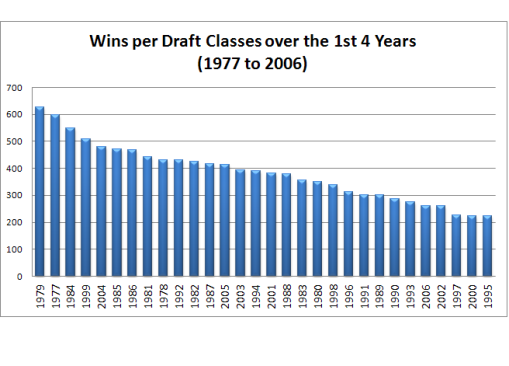
A first overall pick is expected to not only be a good player, but a great player, and, hopefully, better than any other player in that year's draft. Although NBA teams don't always get it right, the productivity of first overall picks is much higher than the productivity of any other pick. Arturo Galletti has done a lot of work on the productivity of draft picks, and he determined that the average WP48 of the first pick (for the years 1977-2006) is 0.169. The next most valuable pick is the third pick (yes, ahead of the second) at a WP48 of 0.133. The best player in the draft usually has a WP48 around 0.278, and the 20th best player usually has a WP48 of around 0.048. With that in mind, who were the last 12 first overall picks in the NBA draft (12 because John Wall and Blake Griffin have yet to play in a regular season game), and how productive have they been over the course of their careers?


Hmm. So Bargnani doesn't really compare very well to those players, or to what we should come to expect from a first overall pick? Who would've known. Bargnani and Bogut are not even remotely comparable (Bogut has almost 34 wins on him). In his first four years, he actually managed to produce a number of losses even greater than the number of wins that Kwame (who is popularly - and deservedly - regarded as a bust) produced in his first four seasons. You think that's bad? It gets even worse for Bargnani when you consider that:
  • Bogut, Howard, and James all improved significantly in the years following their 4th season
  • Rose and Oden improved on their rookie years during their second seasons
  • Blake Griffin is on the cusp of what appears to be an excellent rookie season
  • Without playing a single game, Griffin and Wall have been more productive than him
Maybe it was a weak draft year? Well yes, 2006 was a weak draft class (thanks again to Arturo), but there were still plenty of productive players available in that draft.

Nope, I think I'm going to have to pull a Bill Walton again: Andrea Bargnani was a terrrrrrible first overall pick. In fact, the expectation to be productive magnifies his lack of production, and so Arturo ranks him the tenth worst pick - at any draft position - of the last 30 years.

Let me let reiterate: the choice to select Bargnani as the first overall pick was worse than every other draft decision made in the last 30 years, with the exception of the drafting of the following players:
Not exactly elite company, is it? I think it's safe to say that - by any stretch of the imagination - Bargnani's been a bust of colossal proportions.


"Bargnani has a single valuable skill"

Basketball is about scoring more points than the other team, something I've written about before (and you should probably read that if you haven't already). In order to win, you have to be good at both scoring and preventing your opponent from scoring. Andrea is not good at preventing others from scoring; he doesn't rebound well, pass the ball well, or steal well, and is around average when it comes to getting blocks. He doesn't turn the ball over. His defense is below average; he's improved over the years and isn't as bad as he used to be, but no one is going to mistake him for Dwight Howard. The one advantage Bargnani has over other bigs is his shooting, as he is above average with regards to Adj.FG%, FT%, FG attempts, and points scored.

The problem is that Bargnani's "unique and valuable skill" of perimeter shooting...isn't all that valuable. If you want to score points, there are two areas on the court you should be shooting from: 1) the immediate basket area and 2) the three-point line. All those deep twos and midrange shots? Inefficient. That's because the farther you get from the basket, the harder is is to make your shots, and the lower your percentages get. The reason why three-point shots are useful is because of the extra point. If you are shooting from somewhere other than the immediate basket area, it should be from the three-point line.

How have Bargnani's shot attempts changed over the years?


As you can see, shot attempts increased everywhere on the court, except for 3pt shots. The shots that increased the most were <10ft and 16-23ft shots (also of note: his percentages for shots other than threes and layups were abnormally high. I expect that, while part of the increase may be due to true improvement, most of it was due to random luck). He takes deep twos at almost the same rate that he takes threes; if you are going to be taking long-range shots, why not take a few steps back and go for the extra point? So, while Bargnani is a good shooter, he'd be even better if he started taking more threes and driving to the basket more often, and cut back on the other types of shots as much as possible.

And I think that's the reason why deep-shooting big men are so rare: big men are the tallest players on the court, and as such, are able to park themselves right next to the basket and score a bunch of easy points. A big man who doesn't do this is wasting his key talent - being tall. The big guys on your team must be able to rebound and get easy points next to the basket and Andrea doesn't do either of those things. Until he learns how to do those things, he will forever be an inefficient, unproductive player.

 - Devin