New readers, check out the basics before leaving any comments.
I’ll offer more in-depth coverage shortly, but here are my quick thoughts on the 2011 NBA draft. If you need more draft data in the meantime, take a look at my full draft prospects preview.

Basketball analysis focusing on Canada's lone NBA team
Showing posts with label draft. Show all posts
Showing posts with label draft. Show all posts
Sunday, June 26, 2011


Saturday, June 4, 2011
2010-11 League Opponent Stats
New readers, please check out the basics before leaving any comments.
It's been over a week since I posted the league team stats...time to get the league opponent stats up.
Here they are (full spreadsheet available here):
Monday, May 16, 2011
2011 NBA Draft Prospects Overview
New readers, please check out the basics before leaving any comments.
In case you've been stuck under a rock for the past few months, you'll know that the NBA draft is coming up shortly. My team of choice (for now....) is the Toronto Raptors; the Raptors will likely have a top three pick and can fall no lower than 6th. My question is, according to the numbers, which players should the Raptors (or any other team, for that matter) target?
Well, I have a post written up and ready with all of the numbers included, but I'm actually going to keep that unpublished until right before the draft. Why? Let's just say that it'll be some good content to help launch a new website. So for now, I'm going to operate contrary to my normal M.O. and post some stat-free player assessments, organized into five categories: players to avoid, promising players, overrated players, underrated players, and "mystery box" players
Saturday, April 2, 2011
The Regend and the Ninja: A Response (part II)
New readers, please check out the basics before leaving any comments.
On Saturday, Tom Liston of Raptors Republic - TrueHoop's Raptors' affiliate - wrote a column about Reggie Evans and James Johnson. In his column, Tom mentions that he has some problems with Wins Produced and my analysis of Evans and Johnson in the past. Specifically, Tom's main issues seem to be:
The other day I responded to these first two points. Today I'm going to tackle the last two.
On Saturday, Tom Liston of Raptors Republic - TrueHoop's Raptors' affiliate - wrote a column about Reggie Evans and James Johnson. In his column, Tom mentions that he has some problems with Wins Produced and my analysis of Evans and Johnson in the past. Specifically, Tom's main issues seem to be:
- Evans' WP48 is near the top of the league (currently at 0.356), but Reggie doesn't seem to belong with the other players (Kevin Love, Dwight Howard, Chris Paul, LeBron James, Dwayne Wade) at the top.
- If Wins Produced doesn't overvalue rebounds, and the only thing Evans' does well is rebound, why is Evans' WP48 so high?
- James Johnson is playing well in Toronto - "he’s pretty much exactly the same player" as he was during his rookie season. So why did I say that he probably wouldn't be a good player when Toronto traded for him?
- Wins Produced is one measure of player productivity among several, and one should "never rely on one metric to draw conclusions".
The other day I responded to these first two points. Today I'm going to tackle the last two.
Wednesday, February 16, 2011
ESPN's Chad Ford: Colangelo won't trade Bargnani
New readers, please check out the basics before leaving any comments
Raptors HQ brought the following quote from Chad Ford of EPSN to my attention today:
Raptors HQ brought the following quote from Chad Ford of EPSN to my attention today:
Herman (Toronto)
With Ed Davis and Amir Johnson showing signs of potential. Does there come a time when Toronto looks to trade Bargnani? Maybe they should take a shot at Odem?
Chad Ford(1:36 PM)
It's a good question. The answer is ... not as long as Bryan Colangelo is the GM. GMs fall in love with the players they draft. It's part of our psychological need to justify our decisions. Colangelo took him No. 1 over Rudy Gay and Brandon Roy. He needs to be right. Trading him is tantamount to admitting he was a bad pick. Lakers are suffering from the same problem with Bynum. As a rule around the league, teams tend to overvalue their own players and undervalue other team's players. It's partly why we don't see more trades in the NBA. But if Colangelo were to leave the Raptors, my guess is the first move a new GM would make would be to trade Bargnani. He's talented, but it's tough to have a 7 footer on the floor who refuses to rebound or defend anyone.
Friday, February 4, 2011
Champions and Drafted Players
New readers, please check out the basics before leaving any comments.
I've been away for a while, so I've been writing a bunch of new posts in the short term. Today I'd like to revisit a classic topic: NBA champions and the draft.
I've already shown that securing a top tree draft selection is generally not the ideal position to be in for an NBA team. To recap, I found that:
I've been away for a while, so I've been writing a bunch of new posts in the short term. Today I'd like to revisit a classic topic: NBA champions and the draft.
 |
| Congraturation! |
I've already shown that securing a top tree draft selection is generally not the ideal position to be in for an NBA team. To recap, I found that:
- in the lottery era (1985-present), 60% of teams that have ended up with a top three draft pick haven't made it past the first round of the NBA playoffs during their draftee's first four years in the league.
- to put it another way, only 40% of teams with a top three draft selection managed to advance past the first round in one or more of their draftees' first four years.
- during the lottery era - only four (Duncan, Robinson, Sean Elliott, who was traded away and then reacquired, and Darko Milicic, who shouldn't count because he didn't really play) out of the 78 players (5%) taken with a top three pick have won a championship with the team that drafted them.
- all that makes sense, as top three draft picks generally start their careers on bad teams. The Spurs lucked out with Duncan because, rather than being a bad team, they were a good team that had injury problems. The Pistons "lucked out" with Milicic because the Grizzlies were dumb enough to trade away their 2003 1st round pick in exchange for Otis Thorpe. Robinson and Elliott won their championships well after they were drafted, and Elliott was actually traded away and reacquired before he got his.
- top three picks fared a little bit better in the pre-lottery era - ten players (Jordan, Olajuwon, Worthy, Thomas, McHale, Magic, Walton, Kareem, Unseld, and Cazzie Russell) out of the 57 top three draftees (17.5%) eventually won with the team that drafted them, and only 28% of teams couldn't make it past the first round in their draftee's first four years.
- this also makes sense, as there were fewer teams in the pre-lottery days, which gave each team a better chance of moving up in the standings.
Thursday, December 2, 2010
Top 3 draft picks (part II)
New readers, please read the basics before leaving any comments.
As a follow-up to the last post about top three draft picks, I've made some modifications to my first table (new spreadsheet still here):
Certain people were blinded by some big numbers, so I added some new parts. The first, "title teams without own top 3 draft pick," is pretty self-explanatory, but I figure I'd better explain it anyways. That counts the number of teams that won a championship without having a player on their roster that said team drafted in the top three slots. Any difference between the numbers in this new category and the previous number of 88.9% (40/45) can be explained by trades or free agency. That means that only 29 teams - 64.4% - of teams that won a championship won it with a player that they themselves took with a top three selection. Not as rosy a number, is it?
It's still a rather large number, but as with John McCain, it gets worse (sorry Canadian readers, you'll have to go to the Comedy Network site instead...trust me, I hate it too). The last category explains the number of top three picks that won one or more championships with the team that drafted them. Of the 135 top three picks taken from 1966-2010, only 13 (not 16 as it says in the table, because Baylor, West, and Barry were drafted before 1966) managed to win a championship with the team that drafted them. Between them, these 13 players have managed to win 27 championships. Who are these players, and how many titles did they win with the team that drafted them?
The fact is that very few teams that have a top three pick will celebrate a championship with the player they draft; only 9.6% of teams have managed to win a championship with a top three pick that they've drafted (from 1966-2010). In order to be successful, teams need to have several good players and at least one superstar player. Most rookies aren't superstar players, and most top three picks don't play with good teammates. All of this leads me to say (again) that the Raptors need to build a good team, ditch bad contracts, learn how to draft, and stop worrying about tanking.
Next time I talk about top three picks, I'm going to compare championship teams to non-championship teams. Originally I was going to include that analysis in this post, but it's going to take a lot of work and be rather long, so this'll have to tide you over for now.
- Devin
As a follow-up to the last post about top three draft picks, I've made some modifications to my first table (new spreadsheet still here):
Certain people were blinded by some big numbers, so I added some new parts. The first, "title teams without own top 3 draft pick," is pretty self-explanatory, but I figure I'd better explain it anyways. That counts the number of teams that won a championship without having a player on their roster that said team drafted in the top three slots. Any difference between the numbers in this new category and the previous number of 88.9% (40/45) can be explained by trades or free agency. That means that only 29 teams - 64.4% - of teams that won a championship won it with a player that they themselves took with a top three selection. Not as rosy a number, is it?
It's still a rather large number, but as with John McCain, it gets worse (sorry Canadian readers, you'll have to go to the Comedy Network site instead...trust me, I hate it too). The last category explains the number of top three picks that won one or more championships with the team that drafted them. Of the 135 top three picks taken from 1966-2010, only 13 (not 16 as it says in the table, because Baylor, West, and Barry were drafted before 1966) managed to win a championship with the team that drafted them. Between them, these 13 players have managed to win 27 championships. Who are these players, and how many titles did they win with the team that drafted them?
- Michael Jordan, 6
- Magic Johnson, 5
- Tim Duncan, 4
- Kevin McHale, 3
- Hakeem Olajuwon, 2
- David Robinson, 2
- Isiah Thomas, 2
- Kareem Abdul-Jabbar, 1
- Bill Walton, 1
- Wes Unseld, 1
- Sean Elliott, 1
- Darko Milicic, 1
- Cazzie Russell, 1
The fact is that very few teams that have a top three pick will celebrate a championship with the player they draft; only 9.6% of teams have managed to win a championship with a top three pick that they've drafted (from 1966-2010). In order to be successful, teams need to have several good players and at least one superstar player. Most rookies aren't superstar players, and most top three picks don't play with good teammates. All of this leads me to say (again) that the Raptors need to build a good team, ditch bad contracts, learn how to draft, and stop worrying about tanking.
Next time I talk about top three picks, I'm going to compare championship teams to non-championship teams. Originally I was going to include that analysis in this post, but it's going to take a lot of work and be rather long, so this'll have to tide you over for now.
- Devin
Tuesday, November 16, 2010
Is a top 3 pick necessary to win a title?
Readers, if you haven't read the basics, make sure you do so before you leave any comments.
Commenter khandor left the following comments on part three of my AGS audit on the Raptors' front office:
I disagreed for the following reasons:
But khandor is not so easily convinced. So I put together a list of the number of top three picks on every NBA champion since 1966 (the first draft year without a territorial draft pick). In order for khandor to be correct, a majority of these teams must have at least one top three pick. Here is the summary (full spreadsheet here):
It appears that 88.9% of championship winning teams have at least one top three draft pick. That settles it then; khandor is right and I'm wrong...right?
No. Simply looking at the number of players drafted in the top three on each championship team is not a good way of tackling this question, because those numbers include players who signed as free agents or were traded for. The real question is: if the Raptors secure a top three draft choice, will that put them on the path towards a title? In other words, how do teams with top three draft picks fare historically?
To answer this question, I've put together two spreadsheets. One sheet covers the lottery era (1985-present); the other covers the non-territorial pre-lottery era (1966-1984). Each of these sheets:
Wow, that gives us a completely different answer than the first method. Of the 78 instances of a team drafting a top three pick in the lottery era, a full 28% did not make/have not made the playoffs in any of the first four seasons of their drafted player. Another 32% only managed to lose in the first round. So 60% of teams that had a top three pick did not make it past the first round over the course of their draftee's rookie contract. Shockingly, only two top three picks managed to "lead" (hint) their teams to a title during their first four seasons during the lottery era - can you name the players? That's right, all-time greats Tim Duncan and Darko Milicic. Obviously, Milicic isn't an all-time great; he played very few minutes during his time in Detroit, and when he did play, he didn't help his team at all. But he does meet our requirements for the purposes of this exercise.
An additional two teams - the Spurs with Sean Elliott and the Spurs with David Robinson - ended up winning one or more championships with their own top three draft pick after their player's first four years, and three more teams won championships without their drafted player, sometime after their player was drafted. One of those three teams was Boston after drafting Len Bias in 1986 (who - to put it quite frankly - didn't exactly contribute to the Celtics win in 2008). The second team was Boston after drafting Chauncey Billups in 1997, and that wasn't much better, because he was traded to Toronto (who, being Toronto, also traded him away) midway through his rookie season for Kenny Anderson (who was eventually traded for...wait for it...Vin Baker). But Detroit and Grant Hill in 1994 is the last one, and the most appropriate, because the Pistons manage to get the incredibly productive Ben Wallace when Hill forced a sign and trade to the Magic. Ben Wallace (along with the aforementioned Billups) was the driving force behind the very good 2000's Pistons teams that won one title.
All in all, if we really want to evaluate things properly, we would say that only four top three draft picks taken during the lottery era - about 5% - actually helped their teams win a championship. Not a very good result. But that's just the lottery era - what about top three picks taken from 1966-1984? Here is the summary for those years (full spreadsheet here):
Very interesting! The pre-lottery era was a lot different from the lottery era. Very few teams with top three picks - only 8 out of 57 - missed the playoffs every year for the first four years following the drafting of their player, and the same number of teams only managed to reach the first round. That means that 72% of teams made it past the first round within four years of using a top three pick, which is pretty amazing. Actually, why don't we just use a graph to show the differences:
There, that's better. I removed the last category of the two tables - "Teams winning Championship (after drafting player)" - because the teams with older lottery picks have the built-in advantage of extra opportunities (ie: more years) to add to their championship titles. For example, Chicago drafted Clem Haskins with the third pick of the 1967 draft, but I don't think he should receive any credit for any of the six championships that Chicago ended up winning during the '90s. But the remaining categories have not been affected at all and are still comparable. And what we see is that prior to 1985, teams with top three draft picks ended up deeper in the playoffs than the teams from the lottery era. If you think about it, it's not all that surprising. The lottery system is a fairer way of determining draft order than a coin flip, so on average, top three picks have been playing on worse teams, which means they don't advance as far into the playoffs.
So what do all these charts, graphs, and tables tell us? If the Raptors secure a top three pick, there are a couple of things that will be likely:
Commenter khandor left the following comments on part three of my AGS audit on the Raptors' front office:
If the Raptors truly wish to turn around what is a mess of a franchise on the court and a huge winner from a financial standpoint ... which to this point, unfortunately, there is no such evidence of actually being the case ... then what they NEED to do is finish with one of the 3 worst W-L records in the NBA this season, in order to obtain a Top 3 Pick in the 2011 NBA Draft, and the future rights to a franchise player like Harrison Barnes.
...When you compare the number of championship NBA teams with one or more Top 3 Draft Picks on their roster, to those without any Top 3 Draft Picks at all, it quickly becomes obvious just how important it is to obtain players who fit into this category, if your team is truly serious about ever winning the League Championship one day in the not-too distant future. [... which is not to say that merely having any old Top 3 Draft Pick on the roster, at all, is good enough to get the job done right, because the history of the league clearly shows that it is not the case by any stretch of the imagination.]
I disagreed for the following reasons:
- You don't need to have a high lottery pick to get a productive rookie. In 2006 alone, Rondo went at 21 and Millsap at 47. If you have a way of predicting rookie productivity, then you don't even to get a lottery pick at all. See Arturo Galletti's work on the subject
- Arturo found that the majority of the most productive players from each draft were drafted outside of the top 8 picks. While there have been some good top 3 picks, there are always good players available outside the top 3. You don't need a top 3 pick to win a championship.
- The Raptors have a large trade exception they should use before the trade deadline (because it expires in June). If they use it to net some good players, they will not only be a better team and win more games, but the incoming players (depending on their level of stardom) may expect to make the playoffs (and the last thing the Raptors want on their hands is another disgruntled star)
But khandor is not so easily convinced. So I put together a list of the number of top three picks on every NBA champion since 1966 (the first draft year without a territorial draft pick). In order for khandor to be correct, a majority of these teams must have at least one top three pick. Here is the summary (full spreadsheet here):
It appears that 88.9% of championship winning teams have at least one top three draft pick. That settles it then; khandor is right and I'm wrong...right?
No. Simply looking at the number of players drafted in the top three on each championship team is not a good way of tackling this question, because those numbers include players who signed as free agents or were traded for. The real question is: if the Raptors secure a top three draft choice, will that put them on the path towards a title? In other words, how do teams with top three draft picks fare historically?
To answer this question, I've put together two spreadsheets. One sheet covers the lottery era (1985-present); the other covers the non-territorial pre-lottery era (1966-1984). Each of these sheets:
- records the peak success (best playoff result) of each team with a top three pick over the first four years of a draftee's career (because four years is the length of a rookie contract)
- records the number of championships each drafting team won with the drafted player on their roster
- records the number of championships each drafting team won after they drafted their player
Wow, that gives us a completely different answer than the first method. Of the 78 instances of a team drafting a top three pick in the lottery era, a full 28% did not make/have not made the playoffs in any of the first four seasons of their drafted player. Another 32% only managed to lose in the first round. So 60% of teams that had a top three pick did not make it past the first round over the course of their draftee's rookie contract. Shockingly, only two top three picks managed to "lead" (hint) their teams to a title during their first four seasons during the lottery era - can you name the players? That's right, all-time greats Tim Duncan and Darko Milicic. Obviously, Milicic isn't an all-time great; he played very few minutes during his time in Detroit, and when he did play, he didn't help his team at all. But he does meet our requirements for the purposes of this exercise.
An additional two teams - the Spurs with Sean Elliott and the Spurs with David Robinson - ended up winning one or more championships with their own top three draft pick after their player's first four years, and three more teams won championships without their drafted player, sometime after their player was drafted. One of those three teams was Boston after drafting Len Bias in 1986 (who - to put it quite frankly - didn't exactly contribute to the Celtics win in 2008). The second team was Boston after drafting Chauncey Billups in 1997, and that wasn't much better, because he was traded to Toronto (who, being Toronto, also traded him away) midway through his rookie season for Kenny Anderson (who was eventually traded for...wait for it...Vin Baker). But Detroit and Grant Hill in 1994 is the last one, and the most appropriate, because the Pistons manage to get the incredibly productive Ben Wallace when Hill forced a sign and trade to the Magic. Ben Wallace (along with the aforementioned Billups) was the driving force behind the very good 2000's Pistons teams that won one title.
All in all, if we really want to evaluate things properly, we would say that only four top three draft picks taken during the lottery era - about 5% - actually helped their teams win a championship. Not a very good result. But that's just the lottery era - what about top three picks taken from 1966-1984? Here is the summary for those years (full spreadsheet here):
Very interesting! The pre-lottery era was a lot different from the lottery era. Very few teams with top three picks - only 8 out of 57 - missed the playoffs every year for the first four years following the drafting of their player, and the same number of teams only managed to reach the first round. That means that 72% of teams made it past the first round within four years of using a top three pick, which is pretty amazing. Actually, why don't we just use a graph to show the differences:
There, that's better. I removed the last category of the two tables - "Teams winning Championship (after drafting player)" - because the teams with older lottery picks have the built-in advantage of extra opportunities (ie: more years) to add to their championship titles. For example, Chicago drafted Clem Haskins with the third pick of the 1967 draft, but I don't think he should receive any credit for any of the six championships that Chicago ended up winning during the '90s. But the remaining categories have not been affected at all and are still comparable. And what we see is that prior to 1985, teams with top three draft picks ended up deeper in the playoffs than the teams from the lottery era. If you think about it, it's not all that surprising. The lottery system is a fairer way of determining draft order than a coin flip, so on average, top three picks have been playing on worse teams, which means they don't advance as far into the playoffs.
So what do all these charts, graphs, and tables tell us? If the Raptors secure a top three pick, there are a couple of things that will be likely:
- they will be a bad team (they secured a top three pick, after all)
- they will have a hard time making it past the first round, let alone win a championship
- therefore, a top three pick won't pave the way to a title
The data I have shown in this post adds further support to my position that the Raptors do not need to get a top three pick in this year's - or any year's - draft in order to be successful. The best teams are good at drafting productive players regardless of their draft position, signing productive free agents, and making trades for productive players and extra draft picks. If the Raptors want to be successful in the future, those are the things they need to be focused on, instead of being focused on securing a good draft position.
- Devin
Truehoop says the 2006 draft class is "rotten"
Today, Henry Abbott of Truehoop offered the following observation:
Yes, the 2006 draft class was not a very productive group of players. However, I've been over this before: Bargnani was not in the top 7, the top 10, or even the top 20. Even PER (a terribly flawed metric that rewards shot attempts) rates his first four seasons as 13th best.
Of the players taken in the 2006 draft, Rondo, Balkman, Roy, Millsap, Brewer, and Powe were in the top 7 in terms of per-minute production. Over the last two season Balkman has suffered from George Karl's wrath and Powe has been injured. Brewer spent most of last season out with injury. The next players on the list are Josh Boone (not on an NBA team this year), Kyle Lowry (who has had a terrible year so far), and Thabo Sefolosha. Sefolosha, despite has tiny PER, is a good player - he just doesn't shoot very much. There were a full 11 players from the 2006 draft who played at an above-average level (WP48 of 0.100 or higher) over the course of their first four seasons. The big problem was that the productive players were not selected in the top 10, and thus didn't really get the court time to prove their worth. But when they did - like Millsap, Rondo, and Powe - they excelled. Additionally, unproductive players like Bargnani and Morrison were selected in the top 3 - the top 3! - and several lottery players never even played a minute in the league. The problem with the 2006 draft class wasn't necessarily the fault of the players; it was more of a function of the drafting teams being bad at identifying promising talent.
Arturo Galletti has done a ton of work on this subject - go check out his work right now!
- Devin
Remember that draft? It was actually pretty fun. In the days leading up to it, nobody knew who'd go first. There was some sentiment for LaMarcus Aldridge, who had length and skill but couldn't bench press much. Tyrus Thomas -- an incredible athlete -- earned some consideration. But in the end, a relatively unknown young Andrea Bargnani was the top pick.
As that crew enters its fifth season, it's time for the 2006 draft class to stop trading on potential. These players are squarely in their primes, and some things are coming into focus:
- Neither Aldridge, Bargnani nor Thomas should have been the top pick.
- Based on production thus far, the seven best have been Rajon Rondo, Brandon Roy (although his production is way down), Rudy Gay, Aldridge, Bargnani, Tyrus Thomas (his 23.2 PER this season is 15th in the NBA) and Paul Millsap (who leads the class with a 24.9 PER).
- That was a terrible draft.
Yes, the 2006 draft class was not a very productive group of players. However, I've been over this before: Bargnani was not in the top 7, the top 10, or even the top 20. Even PER (a terribly flawed metric that rewards shot attempts) rates his first four seasons as 13th best.
Of the players taken in the 2006 draft, Rondo, Balkman, Roy, Millsap, Brewer, and Powe were in the top 7 in terms of per-minute production. Over the last two season Balkman has suffered from George Karl's wrath and Powe has been injured. Brewer spent most of last season out with injury. The next players on the list are Josh Boone (not on an NBA team this year), Kyle Lowry (who has had a terrible year so far), and Thabo Sefolosha. Sefolosha, despite has tiny PER, is a good player - he just doesn't shoot very much. There were a full 11 players from the 2006 draft who played at an above-average level (WP48 of 0.100 or higher) over the course of their first four seasons. The big problem was that the productive players were not selected in the top 10, and thus didn't really get the court time to prove their worth. But when they did - like Millsap, Rondo, and Powe - they excelled. Additionally, unproductive players like Bargnani and Morrison were selected in the top 3 - the top 3! - and several lottery players never even played a minute in the league. The problem with the 2006 draft class wasn't necessarily the fault of the players; it was more of a function of the drafting teams being bad at identifying promising talent.
Arturo Galletti has done a ton of work on this subject - go check out his work right now!
- Devin
Sunday, November 7, 2010
Another 'Bargnani is a Bust' Post
New readers, please go check out the basics before you leave any comments on this post.
Every time I mention that Bargnani was a terrible pick and list players from the 2006 draft that I would prefer instead of him, I still get readers would question my sanity and insult me. Of course, they never explain why I'm wrong, they just like making unsubstantiated ad hominem attacks. But I have collected even more information that should make it abundantly clear that Bargnani was a rancid pick.
How does Bargnani compare to other #1 picks?
In a previous post, I compared Bargnani's Wins Produced numbers to the last 12 years of first overall picks. This time, I've added all the advanced numbers, such as PPS, per 48 minute stats, and even PER and Win Shares (note: I do not condone use of Win Shares or PER - especially PER). I've also extended the comparison down to Olowokandi and included Darko Milicic (who was actually a second overall pick), because those are the two players Bargnani apologists inevitably claim were worse than picks than Bargnani. And remember: these numbers only include the first four seasons of each player's career. Here are the more complete numbers (spreadsheet here), this time in the form of a handy little gadget which (if it works correctly) should allow you to sort by whatever category you want:
To sort the columns, go to 'define groupings and calculations', select the column you want to sort, hit the arrow, and then click 'next' and then 'OK'. To remove a grouping, highlight the category you want to remove and click the blank button (which is underneath the one with the arrow). Unfortunately, it seems like it can only order values from smallest to largest, but it's better than giving you a plain spreadsheet. RSS users, please visit the actual website to view these numbers, as the gadget doesn't seem to work in feeds.
What do the numbers tell us? Well for one, Andrea Bargnani does not compare very favourably to the rest of these players. Ranked by WP48 he is dead last behind Olowokandi, Milicic, and Brown. If for some reason you don't "agree" with Wins Produced, ranked by PER (worth repeating: I do not condone use of PER) he is 11th (ahead of Brown, Milicic, and Olowokandi), and ranked by Win Shares (worth repeating: I do not condone use of Win Shares) he is 12th, ahead of Olowokandi and the small sample size of John Wall. If you weigh all three metrics (WP, WS, and PER) equally (which, again, I do not) and take the cumulative rank - 'Combo Rank' - Bargnani comes out 2nd last, behind Milicic and ahead of Olowokandi. Regardless of how you slice it, Bargnani was bad for a first overall pick.
But something interesting happens when you sort these players by points per 48 minutes; all of the sudden Bargnani moves up to 7th place, ahead of notably better players like Dwight Howard, Greg Oden, and Andrew Bogut. As David Berri has mentioned over and over, the popular way of evaluating NBA players is by points scored, so it should be no surprise that so many fans (and certain GMs) have problems recognizing that Bargnani is not very productive. Casual fans are blinded by the relatively large amounts of points that Bargnani scores, failing to notice his lack of production in other areas - such as rebounding - or his shooting efficiency (Bargnani is also 4th in FG attempts).
For a good laugh, try sorting all of the players by rebounds. Bargnani places 11th, just ahead of SF Lebron James. It should be noted that Lebron entered the league when he was two years younger than Bargnani and that at the moment Lebron has actually rebounded at a better rate than Bargnani during his career.
Also, note the age of each player - Bargnani is as old as Milicic and Howard, who both entered the league out of high school. Still expecting Bargnani to 'make a leap' this season? Those who do expect a leap...do you expect a leap out of Howard and/or Milicic?
How does Bargnani compare to other members of the 2006 draft class?
In one of those previous posts up above, I compared Bargnani's Wins Produced numbers to the rest of the 2006 draft class. This time - as with the #1 picks - I've added all the advanced numbers, such as PPS, per 48 minute stats, and even PER and Win Shares (note: I do not condone use of Win Shares or PER - especially PER). Remember: these numbers only include the first four seasons of each player's career. Here are the more complete numbers (spreadsheet here), again in the form of a handy little gadget which (if it works correctly) should allow you to sort by whatever category you want:
Again, to sort the columns, go to 'define groupings and calculations', select the column you want to sort, hit the arrow, and then click 'next' and then 'OK'. To remove a grouping, highlight the category you want to remove and click the blank button (which is underneath the one with the arrow). RSS users, please visit the actual website to view these numbers, as the gadget doesn't seem to work in feeds.
Bargnani ranks 27th out of 30 - or 4th last - in terms of WP48. The players he finishes ahead of are Hilton Armstrong, Ryan Hollins, and Adam Morrison (one of the worst players of all time). If for some reason you don't "agree" with Wins Produced, ranked by PER (worth repeating: I do not condone use of PER) he is 13th (because PER rewards players who take a lot of shots, he finishes ahead of good players such as Shelden Williams and Thabo Sefolosha), and ranked by Win Shares (worth repeating: I do not condone use of Win Shares) he is 23rd. If you take the Combo Rank, Bargnani is ranked 22nd. So no matter how you slice it, Bargnani was not a good choice and not even in the top 10, top 15, or top 20 players of the 2006 draft.
But once again, something interesting happens when you sort these players by points per 48 minutes; all of the sudden Bargnani moves up to 4th place, ahead of several better players like Rajon Rondo, Paul Millsap, Leon Powe, and Ronnie Brewer. Blinded by scoring, many delusional Raptor fans will say that even if Bargnani wasn't the best player that year, at least he was in the top ten. However, we shouldn't forget about other aspects of the game when we evaluate players; in rebounding, Bargnani places 14th behind F Shawne Williams, G/F Thabo Sefolosha, and just ahead of G/F Rudy Gay and PG Rajon Rondo.
As the most comprehensive 'Bargnani is a bust' post I've written to date, hopefully it will help more people realize that Bargnani is not a very productive player. The Raptors need to trade Bargnani as soon as possible, before the rest of the league catch on to his lack of production and while his value is at its highest. Exchanging Bargnani for a more productive Centre would do wonders for the franchise and is something that should be GM Bryan Colangelo's number one priority.
- Devin
Sunday, October 31, 2010
AG Standards for Front Offices Audit: Toronto Raptors (Draft History II)
This article uses the Wins Produced metric to discuss the productivity of NBA players. This metric is based on box score statistics that are adjusted for other factors including pace, position and team. A general scale is given for these, and links to advanced explanations are listed at the bottom of the page.
Wins Produced per 48 Minutes (WP48) – The number of wins a player produces in 48 minutes of play. 0.100 is average and 0.250 is considered the “superstar threshold”. A player a WP48 of 0.000 produces no wins, and any player with a negative WP48 produces a negative number a wins (or, if you prefer, a positive number of losses)
For more information on the terms used in this post, please consult the Glossary of Terms.
Last time we looked at the last ten years of Toronto's draft history. The general conclusion? The Raptors are really bad at drafting productive players (or, if you want to put an optimistic spin on it, the Raptors are excellent at drafting unproductive players). But, as bad as they were, maybe some of those draft choices were the best available options? Let's take an individual look at each draft pick and see if the Raptors could have gotten anything better than they did (you might want to follow along with this spreadsheet).
As a Raptor fan, I gotta love the man. But looking at the numbers, Mo Pete wasn't so good in his first four seasons; he only managed a WP48 of 0.050. At the 21st pick, you would expect there to be some more palatable options than that, but was that the case? While there were 7 players with higher WP48s selected after him, the only truly useful players available were Michael Redd and Eduardo Najera. Overall, Mo Pete wasn't too bad of a pick.
DeeAndre Hulett never played a minute in the NBA, and neither did most of the players selected after him. While Jason Hart eventually played 5289 NBA minutes, he didn't play enough in his first four years to qualify. I'd give the Raptors a pass on this pick.
Michael Bradley was actually a pretty good player in limited minutes. Despite that, he never made much of an impact on the NBA, and after the Raptors cut him in 2004, his NBA career was pretty much over. Instead of Bradley, the Raps could've had Mehmet Okur, Jamaal Tinsley, or Samuel Dalembert. The Raptors didn't do too badly with Bradley - now if only they had had the intelligence to play him more minutes.
The 46th pick was traded. Which was fine, because that year there were no useful players available at that number. So far the Raptors have been pretty good.
And so begins the trading of useful draft picks. Kareem Rush was not a productive player - and Chris Jefferies didn't last long enough for us to find out how good he was. Trading down from #20 to #27, the Raptors missed out on the opportunity to draft Tayshaun Prince. Useful players available at #27 included Carlos Boozer, Dan Gadzuric, Luis Scola, and Matt Barnes. Given that the other two players involved in the exchange of these draft picks were Lindsey Hunter and Tracy Murray, I have no choice but to fail this draft decision. Drafting Carlos Boozer or Luis Scola would've been much better than Jefferies.
At #42, Scola and Barnes were still on the board. Yes, the Raptors could've picked up Boozer and Scola in the same draft if they knew what they were doing. And that is why you don't trade away your second round picks: when you hit with them, they have the potential to turn your franchise around.
Chris Bosh was a very good fourth pick - accordingly, Arturo ranks him 144 out of 980 draftees. But there were three players available who were even better than Bosh: Wade, Josh Howard, and Luke Walton. Now, keeping in mind that this ranking only considers the first four years, the only player I would think about drafting instead of Bosh would be (of course) Wade. So the Raptors did very well on this one.
Van der Hare never played in the NBA - and no one else drafted after him was useful. Looks like 2003 was a good drafting year.
Ah, the first monumental Raptor bust of the 21st century! Araujo was such a bad pick that he only managed to last 1585 career minutes. In those minutes, he was very bad (WP48 lower than -0.07). Who could the Raptors have chosen instead? Oh, only Andris Biedrins, Andre Iguodala, Al Jefferson, Kevin Martin, Anderson Varejao, Trevor Ariza, Dorell Wright, Josh Smith, Delonte West, Chris Duhon, Tony Allen, and Jameer Nelson - all above-average (WP48 greater than 0.100) players. It's funny, because the recent development of Bargnani had almost made me forget about Hoffa.
The 39th pick could have been useful - Trevor Ariza and Bernard Robinson were both available. Robinson wasn't all that good, but Ariza certainly was.
Ah, good old Pape. Well, he didn't play enough minutes to get ranked, and he wasn't that productive...but there was nothing after him. Hmmm. Maybe Toronto should have just taken Ariza at the 39th instead of trading down...but they only missed one really decent player, so you can't hold it against them too much. Overall though, 2004 was a bad year.
Busy draft year for the Raptors - let's start with the pick that had so many "experts" laughing: Villanueva. He actually wasn't that bad of a player - he managed a WP48 of 0.072 - and, as a scorer, was overrated, but the biggest problem with picking Villanueva so low was that...there were so many better players available. How many? Only David Lee, Marcin Gortat, Amir Johnson, Andrew Bynum, Luther Head, Danny Granger, Travis Diener, Jason Maxiell, Monta Ellis, Jarrett Jack, Ersan Ilyasova, and Ronny Turiaf. The Raptors could've at least chosen Granger there instead. This pick gets a D.
With Graham, you were never sure if you were getting "good Joey", the player who rebounded well and attacked the basket for easy shots, or "bad Joey", the player who hoisted up silly jumpers and didn't do much else (maybe the twins were playing tricks on us all?). Over his first four years his WP48 was 0.056. Again, instead of Graham, the Raptors could've had David Lee, Marcin Gortat, Amir Johnson, Luther Head, Danny Granger, Travis Diener, Jason Maxiell, Monta Ellis, Jarrett Jack, Ersan Ilyasova, or Ronny Turiaf. This pick gets a D minus.
Instead of seldomly played Roko Ukic, the Raptors could have had Gortat or Amir Johnson. But Ukic is exactly the kind of pick you want to make in the second round: high risk, high reward. All things considered, not a terrible choice.
Uros Slokar: another high risk, high reward pick. This time it didn't pan out, but again, at least Toronto went for it. There were no useful players selected after Slokar either, so this was an okay pick.
Everyone should know by now how badly the Raptors did by choosing Bargnani; I've talked about it several times before. In fact, if you've read those posts you'll know that Bargnani is ranked 970/980 draftees on Arturo's list. Instead of Bargnani, the Raptors could have chosen: Rajon Rondo, Renaldo Balkman, Brandon Roy, Paul Millsap, Ronnie Brewer, Leon Powe, Josh Boone, Kyle Lowry, Thabo Sefolosha, Tyrus Thomas, or Shelden Williams. This pick is an F.
Had the Raptors not traded #20, they could've had Rondo, Balkman, Millsap, Powe, Boone, or Lowry. Instead, the 20th pick was used to sweeten up the Jalen Rose trade, which was simply a correction of a previous mistake...and the resulting cap room led to future mistakes. Dumb.
P.J. Tucker didn't get much of a chance to play in the NBA, but when he did play, he showed promise. And after he left for overseas, he actually managed to achieve some measure of success. So the Raptors took exactly the kind of player they were supposed to, only to cut the guy in favour of Luke Jackson.
Ed Davis seems like he's going to be a very good NBA player, and eventually we will get to see him in action. Based on nothing other than college numbers, it looks as if the Raptors made good pick. Although it must be said that the fact that there were 12 teams drafting ahead of them was probably a big factor in them choosing Davis.
In dropping down from #42 to #50, the Raptors may have missed out on a man with a sexy name, Devin Ebanks, and a man with a humourously erroneous name, Tiny Gallon. I'm not so sure that Alabi was a high risk/high reward player...high risk, certainly, but given that he played in the NCAA and didn't post good numbers, it's not likely that he will turn out to be too productive.
Draft Verdict?
In the last ten years, the Raptors have hit on a draft pick only once (maybe twice if Ed Davis turns out be as good as we think). That is a terrible, putrid rate. Some of the middling picks (late teens to early 30s) were okay, but the Raptors ended up cutting/trading away the draftee too early. Some of their second round picks were at least adventurous, but none of them succeeded. Any time the Raptors get into the lottery, there is a very good chance that they will select someone who not is very productive. To make matters even worse, Toronto has also traded away a rather large number of picks and hasn't made many trades to acquire any back - except for the occasional forced trade, such as the trades involving Carter and Bosh. So really...you can't blame good players for avoiding Toronto.
Wins Produced per 48 Minutes (WP48) – The number of wins a player produces in 48 minutes of play. 0.100 is average and 0.250 is considered the “superstar threshold”. A player a WP48 of 0.000 produces no wins, and any player with a negative WP48 produces a negative number a wins (or, if you prefer, a positive number of losses)
For more information on the terms used in this post, please consult the Glossary of Terms.
Last time we looked at the last ten years of Toronto's draft history. The general conclusion? The Raptors are really bad at drafting productive players (or, if you want to put an optimistic spin on it, the Raptors are excellent at drafting unproductive players). But, as bad as they were, maybe some of those draft choices were the best available options? Let's take an individual look at each draft pick and see if the Raptors could have gotten anything better than they did (you might want to follow along with this spreadsheet).
- 2000: #21 Morris Peterson; #56 DeeAndre Hulett
As a Raptor fan, I gotta love the man. But looking at the numbers, Mo Pete wasn't so good in his first four seasons; he only managed a WP48 of 0.050. At the 21st pick, you would expect there to be some more palatable options than that, but was that the case? While there were 7 players with higher WP48s selected after him, the only truly useful players available were Michael Redd and Eduardo Najera. Overall, Mo Pete wasn't too bad of a pick.
DeeAndre Hulett never played a minute in the NBA, and neither did most of the players selected after him. While Jason Hart eventually played 5289 NBA minutes, he didn't play enough in his first four years to qualify. I'd give the Raptors a pass on this pick.
- 2001: #17 Michael Bradley; #46 (traded)
Michael Bradley was actually a pretty good player in limited minutes. Despite that, he never made much of an impact on the NBA, and after the Raptors cut him in 2004, his NBA career was pretty much over. Instead of Bradley, the Raps could've had Mehmet Okur, Jamaal Tinsley, or Samuel Dalembert. The Raptors didn't do too badly with Bradley - now if only they had had the intelligence to play him more minutes.
The 46th pick was traded. Which was fine, because that year there were no useful players available at that number. So far the Raptors have been pretty good.
- 2002: #20 (traded); #27 Chris Jefferies; #42 (traded)
And so begins the trading of useful draft picks. Kareem Rush was not a productive player - and Chris Jefferies didn't last long enough for us to find out how good he was. Trading down from #20 to #27, the Raptors missed out on the opportunity to draft Tayshaun Prince. Useful players available at #27 included Carlos Boozer, Dan Gadzuric, Luis Scola, and Matt Barnes. Given that the other two players involved in the exchange of these draft picks were Lindsey Hunter and Tracy Murray, I have no choice but to fail this draft decision. Drafting Carlos Boozer or Luis Scola would've been much better than Jefferies.
At #42, Scola and Barnes were still on the board. Yes, the Raptors could've picked up Boozer and Scola in the same draft if they knew what they were doing. And that is why you don't trade away your second round picks: when you hit with them, they have the potential to turn your franchise around.
- 2003: #4 Chris Bosh; #52 Remon Van der Hare
Chris Bosh was a very good fourth pick - accordingly, Arturo ranks him 144 out of 980 draftees. But there were three players available who were even better than Bosh: Wade, Josh Howard, and Luke Walton. Now, keeping in mind that this ranking only considers the first four years, the only player I would think about drafting instead of Bosh would be (of course) Wade. So the Raptors did very well on this one.
Van der Hare never played in the NBA - and no one else drafted after him was useful. Looks like 2003 was a good drafting year.
- 2004: #8 Rafael Araujo; #39 (traded); #47 Pape Sow
Ah, the first monumental Raptor bust of the 21st century! Araujo was such a bad pick that he only managed to last 1585 career minutes. In those minutes, he was very bad (WP48 lower than -0.07). Who could the Raptors have chosen instead? Oh, only Andris Biedrins, Andre Iguodala, Al Jefferson, Kevin Martin, Anderson Varejao, Trevor Ariza, Dorell Wright, Josh Smith, Delonte West, Chris Duhon, Tony Allen, and Jameer Nelson - all above-average (WP48 greater than 0.100) players. It's funny, because the recent development of Bargnani had almost made me forget about Hoffa.
The 39th pick could have been useful - Trevor Ariza and Bernard Robinson were both available. Robinson wasn't all that good, but Ariza certainly was.
Ah, good old Pape. Well, he didn't play enough minutes to get ranked, and he wasn't that productive...but there was nothing after him. Hmmm. Maybe Toronto should have just taken Ariza at the 39th instead of trading down...but they only missed one really decent player, so you can't hold it against them too much. Overall though, 2004 was a bad year.
- 2005: #7 Charlie Villanueva; #11 (traded); #16 Joey Graham; #38 (traded); #41 Roko Ukic; #58 Uros Slokar
Busy draft year for the Raptors - let's start with the pick that had so many "experts" laughing: Villanueva. He actually wasn't that bad of a player - he managed a WP48 of 0.072 - and, as a scorer, was overrated, but the biggest problem with picking Villanueva so low was that...there were so many better players available. How many? Only David Lee, Marcin Gortat, Amir Johnson, Andrew Bynum, Luther Head, Danny Granger, Travis Diener, Jason Maxiell, Monta Ellis, Jarrett Jack, Ersan Ilyasova, and Ronny Turiaf. The Raptors could've at least chosen Granger there instead. This pick gets a D.
With Graham, you were never sure if you were getting "good Joey", the player who rebounded well and attacked the basket for easy shots, or "bad Joey", the player who hoisted up silly jumpers and didn't do much else (maybe the twins were playing tricks on us all?). Over his first four years his WP48 was 0.056. Again, instead of Graham, the Raptors could've had David Lee, Marcin Gortat, Amir Johnson, Luther Head, Danny Granger, Travis Diener, Jason Maxiell, Monta Ellis, Jarrett Jack, Ersan Ilyasova, or Ronny Turiaf. This pick gets a D minus.
Instead of seldomly played Roko Ukic, the Raptors could have had Gortat or Amir Johnson. But Ukic is exactly the kind of pick you want to make in the second round: high risk, high reward. All things considered, not a terrible choice.
Uros Slokar: another high risk, high reward pick. This time it didn't pan out, but again, at least Toronto went for it. There were no useful players selected after Slokar either, so this was an okay pick.
- 2006: #1 Andrea Bargnani; #20 (traded); #35 P.J. Tucker; #56 Edin Bavcic
Everyone should know by now how badly the Raptors did by choosing Bargnani; I've talked about it several times before. In fact, if you've read those posts you'll know that Bargnani is ranked 970/980 draftees on Arturo's list. Instead of Bargnani, the Raptors could have chosen: Rajon Rondo, Renaldo Balkman, Brandon Roy, Paul Millsap, Ronnie Brewer, Leon Powe, Josh Boone, Kyle Lowry, Thabo Sefolosha, Tyrus Thomas, or Shelden Williams. This pick is an F.
Had the Raptors not traded #20, they could've had Rondo, Balkman, Millsap, Powe, Boone, or Lowry. Instead, the 20th pick was used to sweeten up the Jalen Rose trade, which was simply a correction of a previous mistake...and the resulting cap room led to future mistakes. Dumb.
P.J. Tucker didn't get much of a chance to play in the NBA, but when he did play, he showed promise. And after he left for overseas, he actually managed to achieve some measure of success. So the Raptors took exactly the kind of player they were supposed to, only to cut the guy in favour of Luke Jackson.
 |
| As Arturo would say |
Edin Bavcic didn't play - and there was nobody useful picked after him - but again, at least the Raptors were looking for hidden gems
Ah, the year of no picks. Why no picks? Because - years before Colangelo - they needed to get rid of Yogi Stewart and wanted to acquire Lamond Murray and John Wallace. Who could they have picked at #22? Rudy Fernandez, Carl Landry, Marc Gasol, Ramon Sessions, and Jared Dudley. At #52, they still could have had Sessions. Lesson? Don't trade away your picks.
Really? T.J. Ford, Rasho Nesterovic, and the 17th pick for Jermaine O'Neal? The only saving grace of the trade was the cap room that it created, and BC did not use it wisely. The returns are still pretty early, but at #17, the Raptors could have had Luc Mbah a Moute, Serge Ibaka, DeAndre Jordan, Bill Walker, J.J. Hickson, Mario Chalmers, Courtney Lee, Goran Dragic, Ryan Anderson, and Sonny Weems. I'd take any of those players over Jermaine O'Neal, and I'd have been happy to keep T.J. Ford for a bit longer, thank you very much.
Instead of Jawai, Toronto could have had Walker or Dragic. Not too bad, and Jawai was an okay gamble. Those same two players were still available at #45 as well.
Another lottery pick, another poor choice. DeRozan didn't have good numbers coming out of college, and his first year wasn't very good (nor was his preseason this year). DeRozan is shaping up to be your classic Raptors lottery pick bust. Who could the Raptors have had instead? DeJuan Blair, Ty Lawson, Jon Brockman, Chase Budinger, Rodrigue Beaubois, Jonas Jerebko, Austin Daye, Jeff Pendergraph, Taj Gibson, Omri Casspi, or Darren Collison - just to name the above average players. It'll be a few more years before we can fully evaluate this draft class, but it's looking very likely that the Raptors made another poor choice.
Picks #39 and #51 were traded. Remember what I said about trading draft picks? Imagine Jerebko, Budinger, Marcus Thornton, or A.J. Price on the team. At least the Raptors got Carlos Delfino out of it...er, I mean, Amir Johnson (not bad, actually, although I would've preferred to have kept Delfino).
- 2007: #22 (traded); #52 (traded)
Ah, the year of no picks. Why no picks? Because - years before Colangelo - they needed to get rid of Yogi Stewart and wanted to acquire Lamond Murray and John Wallace. Who could they have picked at #22? Rudy Fernandez, Carl Landry, Marc Gasol, Ramon Sessions, and Jared Dudley. At #52, they still could have had Sessions. Lesson? Don't trade away your picks.
- 2008: #17 (traded); #41 Nathan Jawai; #45 (traded)
Really? T.J. Ford, Rasho Nesterovic, and the 17th pick for Jermaine O'Neal? The only saving grace of the trade was the cap room that it created, and BC did not use it wisely. The returns are still pretty early, but at #17, the Raptors could have had Luc Mbah a Moute, Serge Ibaka, DeAndre Jordan, Bill Walker, J.J. Hickson, Mario Chalmers, Courtney Lee, Goran Dragic, Ryan Anderson, and Sonny Weems. I'd take any of those players over Jermaine O'Neal, and I'd have been happy to keep T.J. Ford for a bit longer, thank you very much.
Instead of Jawai, Toronto could have had Walker or Dragic. Not too bad, and Jawai was an okay gamble. Those same two players were still available at #45 as well.
- 2009: #9 DeMar DeRozan; #39 (traded); #51 (traded)
Another lottery pick, another poor choice. DeRozan didn't have good numbers coming out of college, and his first year wasn't very good (nor was his preseason this year). DeRozan is shaping up to be your classic Raptors lottery pick bust. Who could the Raptors have had instead? DeJuan Blair, Ty Lawson, Jon Brockman, Chase Budinger, Rodrigue Beaubois, Jonas Jerebko, Austin Daye, Jeff Pendergraph, Taj Gibson, Omri Casspi, or Darren Collison - just to name the above average players. It'll be a few more years before we can fully evaluate this draft class, but it's looking very likely that the Raptors made another poor choice.
Picks #39 and #51 were traded. Remember what I said about trading draft picks? Imagine Jerebko, Budinger, Marcus Thornton, or A.J. Price on the team. At least the Raptors got Carlos Delfino out of it...er, I mean, Amir Johnson (not bad, actually, although I would've preferred to have kept Delfino).
- 2010: #13 Ed Davis; #42 (traded), #50 Solomon Alabi
Ed Davis seems like he's going to be a very good NBA player, and eventually we will get to see him in action. Based on nothing other than college numbers, it looks as if the Raptors made good pick. Although it must be said that the fact that there were 12 teams drafting ahead of them was probably a big factor in them choosing Davis.
In dropping down from #42 to #50, the Raptors may have missed out on a man with a sexy name, Devin Ebanks, and a man with a humourously erroneous name, Tiny Gallon. I'm not so sure that Alabi was a high risk/high reward player...high risk, certainly, but given that he played in the NCAA and didn't post good numbers, it's not likely that he will turn out to be too productive.
Draft Verdict?
In the last ten years, the Raptors have hit on a draft pick only once (maybe twice if Ed Davis turns out be as good as we think). That is a terrible, putrid rate. Some of the middling picks (late teens to early 30s) were okay, but the Raptors ended up cutting/trading away the draftee too early. Some of their second round picks were at least adventurous, but none of them succeeded. Any time the Raptors get into the lottery, there is a very good chance that they will select someone who not is very productive. To make matters even worse, Toronto has also traded away a rather large number of picks and hasn't made many trades to acquire any back - except for the occasional forced trade, such as the trades involving Carter and Bosh. So really...you can't blame good players for avoiding Toronto.
Next week I'll post Week 1 team stats (as reader Mattt points out, the Raptors are at 0.500 at the moment!), as well as the final part of this AGS front office audit and suggestions for turning the franchise around.
- Devin
- All basic NBA stats, including play time, salary, and age, are from Basketball-Reference
- Shooting data by location are from Hoopdata
- The Wins Produced (WP and WP48) metric is the work of Berri and Schmidt. I use the Automated Wins Produced site, which is powered by data from Basketball-Reference and Yahoo Sports and put together by Andres Alvarez.
- Positional averages (for PPS, etc) are from The Wages of Wins.
- All of the draft data is the work of Arturo Galletti
Wednesday, October 27, 2010
AGS for Front Offices Audit: Toronto Raptors (Part 1:Draft history)
This article uses the Wins Produced metric to discuss the productivity of NBA players. This metric is based on box score statistics that are adjusted for other factors including pace, position and team. A general scale is given for these, and links to advanced explanations are listed at the bottom of the page.
Wins Produced per 48 Minutes (WP48) – The number of wins a player produces in 48 minutes of play. 0.100 is average and 0.250 is considered the “superstar threshold”. A player a WP48 of 0.000 produces no wins, and any player with a negative WP48 produces a negative number a wins (or, if you prefer, a positive number of losses)
For more information on the terms used in this post, please consult the Glossary of Terms.
As promised, let's take a look at the Raptors' management plan. To start, I have been analyzing the organizational philosophy of the Raptors, and after hours of work, I have come up with an image that summarizes my findings:
There are certainly more than a few obstacles for the Raptors to overcome in order for them to simply win a playoff series, let alone a championship. So, using Arturo's standards for evaluating front offices - previously employed by Andres to evaluate the Nuggets front office - let's see what the Raptors are doing well and where they can improve.
1) Get an advanced stats model to gain an edge over other teams. Make sure this model correlates with winning.
Raptors GM Bryan Colangelo seems to be skeptical about stats, and, as far as I am aware, does not have any dedicated statistical analysts working for the team. While he claims to have read parts of The Wages of Wins, he clearly doesn't buy into Wins Produced or he wouldn't have made a lot of the moves has has (Bargnani, Turkoglu, etc). So that's a fail.
2) Bolster your roster with draft picks rather than free agency.
3) Flip scorers for draft picks (see 2).
4) Use later picks on high risk/reward players for a cheaper price.
Let's take a look at what happened to all the draft picks the Raptors have had since 2000. Although Colangelo has only been around since 2006, I think we should also look at how the Raptors did BBC (before Bryan Colangelo), so let's look at the last 10 years of Raptors drafting:
That list doesn't look too good - but we are not done yet. We also have to consider that some of those picks were immediately traded to other teams:
And what about the draft picks that Toronto traded away:
And what about future draft picks they've acquired:
Phew! That was a lot of work. By the way, these last two lists may not be complete - it turns out that it's actually quite difficult to find out what happened to all the draft picks that the Raptors have acquired or traded away over the years (my best resource was, unsurprisingly, Wikipedia). Adding everything above together, how successful has Toronto been with its picks? To evaluate drafted players, we'll turn to Arturo's handy Draft Score spreadsheet, which ranks the past 30 years of draft picks. Since the total number of players drafted is 980, each draftee can be expressed as a percentage (1-n/980). Please note: Arturo's draft numbers are based only on the first four years of a player's career (their rookie contract) and includes only those players who managed to play at least 1600 minutes over four years (400 minutes a year). Numbers for players drafted after 2006 are calculated using Andres Alvarez's Automated Wins Produced.
If you'd rather view this spreadsheet as a webpage, click here.
Given that list, what can we say about the Raptors' recent draft history? Abysmal. Of the 15 retained draftees that could have played four seasons by now, only six were even ranked (ie: nine players didn't even manage to play 400 minutes/season in their first four seasons). The six rankable players - including Chris Bosh - had an average ranking of 517/980 (48%). Take out Bosh (144), and the remaining five players had an average rank of 585/980 (40%). The Raptors simply do not draft well.
Toronto has been the team trading the draft picks in order to get...mostly unproductive bench players. The Raptors fail #2 and #3 big time. Up until 2006 (the first year with Colangelo at the helm), the Raptors were doing okay on #4, but since then, they haven't had any second round picks to use, because they traded them away (not entirely Colangelo's fault, as many of the transactions happened years ago). But because they demonstrated that they have no understanding of the value of second round draft picks, I'm giving them a fail there too.
This post is getting far too long, so I'm going to split it into at least two parts. In the next part, I want to review individual draftees and then see how the Raptors measure up to the last three aspects of Arturo's requirements.
- Devin
Wins Produced per 48 Minutes (WP48) – The number of wins a player produces in 48 minutes of play. 0.100 is average and 0.250 is considered the “superstar threshold”. A player a WP48 of 0.000 produces no wins, and any player with a negative WP48 produces a negative number a wins (or, if you prefer, a positive number of losses)
For more information on the terms used in this post, please consult the Glossary of Terms.
As promised, let's take a look at the Raptors' management plan. To start, I have been analyzing the organizational philosophy of the Raptors, and after hours of work, I have come up with an image that summarizes my findings:
| Hey - I never said I was an artist |
1) Get an advanced stats model to gain an edge over other teams. Make sure this model correlates with winning.
Raptors GM Bryan Colangelo seems to be skeptical about stats, and, as far as I am aware, does not have any dedicated statistical analysts working for the team. While he claims to have read parts of The Wages of Wins, he clearly doesn't buy into Wins Produced or he wouldn't have made a lot of the moves has has (Bargnani, Turkoglu, etc). So that's a fail.
2) Bolster your roster with draft picks rather than free agency.
3) Flip scorers for draft picks (see 2).
4) Use later picks on high risk/reward players for a cheaper price.
Let's take a look at what happened to all the draft picks the Raptors have had since 2000. Although Colangelo has only been around since 2006, I think we should also look at how the Raptors did BBC (before Bryan Colangelo), so let's look at the last 10 years of Raptors drafting:
- 2000: Morris Peterson (21st), DeeAndre Hulett (46st)
- 2001: Michael Bradley (17th)
- 2002: Kareem Rush (20th)
- 2003: Chris Bosh (4th), Remon Van der Hare (52nd)
- 2004: Rafael Araujo (8th), Albert Miralles (39th)
- 2005: Charlie Villanueva (7th), Joey Graham (16th), Roko Ukic (41st), Uros Slokar (58th)
- 2006: Andrea Bargnani (1st), P.J. Tucker (35th), Edin Bavcic (56th)
- 2007: none
- 2008: Roy Hibbert (17th)
- 2009: DeMar DeRozan (9th)
- 2010: Ed Davis (13th)
That list doesn't look too good - but we are not done yet. We also have to consider that some of those picks were immediately traded to other teams:
- Kareem Rush, along with Tracy Murray, and a 2003 draft pick (Luke Walton), to the Lakers for Lindsey Hunter, Chris Jeffries, and a 2003 draft pick (Ramon Van de Hare)
- Roy Hibbert, along with T.J. Ford, Rasho Nesterovic, and Maceo Baston, to Indiana for Jermaine O'Neal and Nathan Jawai
- Acquired Pape Sow and a 2005 draft pick (Uros Slokar) from the Miami Heat for a 2004 draft pick (Albert Miralles)
And what about the draft picks that Toronto traded away:
- 2001 draft pick (Ousmane Cisse), along with Kevin Willis, Alex Radojevic, and Garth Joseph, to the Nuggets for Keon Clark, Tracy Murray, and Mamadou N'Diaye
- 2002 draft pick (Jason Jennings), along with Charles Oakley, to the Bulls for Brian Skinner
- 2005 draft pick (Fran Vasquez), along with Corliss Williamson, Tyrone Corbin, and Kornel David, to the Kings for Jerome Williams and Eric Montross
- 2005 draft pick (Travis Diener), along with Mengke Bateer and Remon Van der Hare, to the Magic for Robert Archibald and a 2005 draft pick (Roko Ukic)
- 2006 draft pick (Renaldo Balkman), along with Jalen Rose, to the Knicks for Antonio Davis
- 2007 draft pick (Jared Dudley), along with Michael Stewart, to the Cavs for Lamond Murray and a 2004 draft pick (Albert Miralles)
- 2007 draft pick (Taurean Green) to Portland for John Wallace
- 2008 draft pick (Goran Dragic) to the Spurs for the rights to Giorgos Printezis
- 2009 draft pick (Jack McClinton), along with Matt Bonner and Eric Williams, to the Spurs for Rasho Nesterovic
- 2009 draft pick (Jonas Jerebko) to the Pistons for Carlos Delfino
- 2010 draft pick (Da'Sean Butler) to the Heat due to the Shawn Marion trade
- 2011 second round draft pick to the Pistons for Carlos Delfino
- 2013 second round draft pick to the Mavs (to acquire Slomon Alabi)
- 2014 second round draft pick to the Celtics (to acquire Patrick O'Bryant)
- 2015 second round draft pick to the Rockets (to acquire David Andersen)
- 2016 second round draft pick to the Grizzlies (to acquire Turkoglu)
And what about future draft picks they've acquired:
- 2011 first round draft pick from Miami (Chris Bosh trade)
- 2015 second round draft pick (51-55 only) from the Clippers for Hassan Adams
Phew! That was a lot of work. By the way, these last two lists may not be complete - it turns out that it's actually quite difficult to find out what happened to all the draft picks that the Raptors have acquired or traded away over the years (my best resource was, unsurprisingly, Wikipedia). Adding everything above together, how successful has Toronto been with its picks? To evaluate drafted players, we'll turn to Arturo's handy Draft Score spreadsheet, which ranks the past 30 years of draft picks. Since the total number of players drafted is 980, each draftee can be expressed as a percentage (1-n/980). Please note: Arturo's draft numbers are based only on the first four years of a player's career (their rookie contract) and includes only those players who managed to play at least 1600 minutes over four years (400 minutes a year). Numbers for players drafted after 2006 are calculated using Andres Alvarez's Automated Wins Produced.
If you'd rather view this spreadsheet as a webpage, click here.
Given that list, what can we say about the Raptors' recent draft history? Abysmal. Of the 15 retained draftees that could have played four seasons by now, only six were even ranked (ie: nine players didn't even manage to play 400 minutes/season in their first four seasons). The six rankable players - including Chris Bosh - had an average ranking of 517/980 (48%). Take out Bosh (144), and the remaining five players had an average rank of 585/980 (40%). The Raptors simply do not draft well.
Toronto has been the team trading the draft picks in order to get...mostly unproductive bench players. The Raptors fail #2 and #3 big time. Up until 2006 (the first year with Colangelo at the helm), the Raptors were doing okay on #4, but since then, they haven't had any second round picks to use, because they traded them away (not entirely Colangelo's fault, as many of the transactions happened years ago). But because they demonstrated that they have no understanding of the value of second round draft picks, I'm giving them a fail there too.
This post is getting far too long, so I'm going to split it into at least two parts. In the next part, I want to review individual draftees and then see how the Raptors measure up to the last three aspects of Arturo's requirements.
- Devin
- All basic NBA stats, including play time, salary, and age, are from Basketball-Reference
- Shooting data by location are from Hoopdata
- The Wins Produced (WP and WP48) metric is the work of Berri and Schmidt. I use the Automated Wins Produced site, which is powered by data from Basketball-Reference and Yahoo Sports and put together by Andres Alvarez.
- Positional averages (for PPS, etc) are from The Wages of Wins.
- All of the draft data is the work of Arturo Galletti
Sunday, October 17, 2010
More on More on Bargnani
This article uses the Wins Produced metric to discuss the productivity of NBA players. This metric is based on box score statistics that are adjusted for other factors including pace, position and team. A general scale is given for these, and links to advanced explanations are listed at the bottom of the page.
Wins Produced per 48 Minutes (WP48) – The number of wins a player produces in 48 minutes of play. 0.100 is average and 0.250 is considered the “superstar threshold”. A player a WP48 of 0.000 produces no wins, and any player with a negative WP48 produces a negative number a wins (or, if you prefer, a positive number of losses)
Wins Produced per 48 Minutes (WP48) – The number of wins a player produces in 48 minutes of play. 0.100 is average and 0.250 is considered the “superstar threshold”. A player a WP48 of 0.000 produces no wins, and any player with a negative WP48 produces a negative number a wins (or, if you prefer, a positive number of losses)
An anonymous reader (by the way, you guys do realize you can create blogger profiles, right?) posed a logical question: if the Raptors shouldn't have selected Bargnani with the first overall pick in the 2006 NBA draft, who should they have chosen instead?
I'll begin answering this question by first looking at the productivity of the 2006 lottery picks (picks 1-14):
As you can see, there weren't that many productive players selected in the top 14. But amongst these 14 players the most productive was Brandon Roy. Roy produced more than 50 more wins than Bargnani over his first four years - not too shabby. I think, given the chance to do the 2006 draft over, everyone in their right mind would be happy with Roy instead of Bargnani.
But Roy was not the most productive player available. The next table shows the productivity of all the players in the 2006 draft who managed to play at least 1600 minutes over four seasons (why the cutoff? Any fewer minutes than that and we don't really get a good indication of a player's productivity):
Rajon Rondo was the most productive player of the 2006 draft. He'd be my number one pick if I had to do the draft over. Renaldo Balkman (who hasn't produced that many wins due to lack of playing time) and Roy are next on the list. Given that the Raptors already had a very productive point guard at the time (Jose Calderon), you couldn't blame them for passing on Rondo and choosing either Balkman or Roy instead.
But notice the trend? Look at the draft numbers of everyone on the list. The most productive player was chosen at #21, second at #20, and the third at #6. Rounding out the top ten most productive players are numbers 47, 14, 49, 23, 24, 13, and 4. And that brings up one of Arturo's most important points: teams are not very good at drafting the best players available. If they were good at recognizing talent, they wouldn't have let Rondo drop all the way to #21, Milsap to #47, etc.
Also note that Bargnani was the 4th least productive player (on a per-minute basis) in the entire 2006 draft. I think the fact that the #1 pick ranks 27th out of 30 players shows that:
- It was a mistake to draft him so high
- He was a monumental bust.
Hopefully that answers all the questions everyone has about Bargnani. I know that - as with everything else - there will be those who will not be swayed by the huge amount of evidence suggesting that Bargnani is a bust. Given that people ignore mountains of evidence all the time, I am not insulted or surprised by this. However, if you are going to come onto this blog and make a case that I am wrong, be prepared to support yourself with facts rather than subjective judgments.
 |
| Penny Arcade says it best |
- Devin
- All basic NBA stats, including play time, salary, and age, are from Basketball-Reference
- Shooting data by location are from Hoopdata
- The Wins Produced (WP and WP48) metric is the work of Berri and Schmidt. I use the Automated Wins Produced site, which is powered by data from Basketball-Reference and Yahoo Sports and put together by Andres Alvarez.
- Positional averages (for PPS, etc) are from The Wages of Wins.
- All of the draft data is the work of Arturo Galletti
Thursday, October 14, 2010
Is Bargnani a bust?
This article uses the Wins Produced metric to discuss the productivity of NBA players. This metric is based on box score statistics that are adjusted for other factors including pace, position and team. A general scale is given for these, and links to advanced explanations are listed at the bottom of the page.
Wins Produced per 48 Minutes (WP48) – The number of wins a player produces in 48 minutes of play. 0.100 is average and 0.250 is considered the “superstar threshold”. A player a WP48 of 0.000 produces no wins, and any player with a negative WP48 produces a negative number a wins (or, if you prefer, a positive number of losses)
Over on TrueHoop today, Zach Harper writes that we shouldn't call Andrea Bargnani a bust just yet:
And additionally, Zach Lowe of The Point Forward, after talking at length about how poorly Bargnani has played thus far in his career, writes:
I have already taken a look at Bargnani's production before, but sure, let's go ahead and revisit this issue.
"Bargnani is not a bust"
A first overall pick is expected to not only be a good player, but a great player, and, hopefully, better than any other player in that year's draft. Although NBA teams don't always get it right, the productivity of first overall picks is much higher than the productivity of any other pick. Arturo Galletti has done a lot of work on the productivity of draft picks, and he determined that the average WP48 of the first pick (for the years 1977-2006) is 0.169. The next most valuable pick is the third pick (yes, ahead of the second) at a WP48 of 0.133. The best player in the draft usually has a WP48 around 0.278, and the 20th best player usually has a WP48 of around 0.048. With that in mind, who were the last 12 first overall picks in the NBA draft (12 because John Wall and Blake Griffin have yet to play in a regular season game), and how productive have they been over the course of their careers?
Hmm. So Bargnani doesn't really compare very well to those players, or to what we should come to expect from a first overall pick? Who would've known. Bargnani and Bogut are not even remotely comparable (Bogut has almost 34 wins on him). In his first four years, he actually managed to produce a number of losses even greater than the number of wins that Kwame (who is popularly - and deservedly - regarded as a bust) produced in his first four seasons. You think that's bad? It gets even worse for Bargnani when you consider that:
Nope, I think I'm going to have to pull a Bill Walton again: Andrea Bargnani was a terrrrrrible first overall pick. In fact, the expectation to be productive magnifies his lack of production, and so Arturo ranks him the tenth worst pick - at any draft position - of the last 30 years.
Let me let reiterate: the choice to select Bargnani as the first overall pick was worse than every other draft decision made in the last 30 years, with the exception of the drafting of the following players:
"Bargnani has a single valuable skill"
Basketball is about scoring more points than the other team, something I've written about before (and you should probably read that if you haven't already). In order to win, you have to be good at both scoring and preventing your opponent from scoring. Andrea is not good at preventing others from scoring; he doesn't rebound well, pass the ball well, or steal well, and is around average when it comes to getting blocks. He doesn't turn the ball over. His defense is below average; he's improved over the years and isn't as bad as he used to be, but no one is going to mistake him for Dwight Howard. The one advantage Bargnani has over other bigs is his shooting, as he is above average with regards to Adj.FG%, FT%, FG attempts, and points scored.
The problem is that Bargnani's "unique and valuable skill" of perimeter shooting...isn't all that valuable. If you want to score points, there are two areas on the court you should be shooting from: 1) the immediate basket area and 2) the three-point line. All those deep twos and midrange shots? Inefficient. That's because the farther you get from the basket, the harder is is to make your shots, and the lower your percentages get. The reason why three-point shots are useful is because of the extra point. If you are shooting from somewhere other than the immediate basket area, it should be from the three-point line.
How have Bargnani's shot attempts changed over the years?
As you can see, shot attempts increased everywhere on the court, except for 3pt shots. The shots that increased the most were <10ft and 16-23ft shots (also of note: his percentages for shots other than threes and layups were abnormally high. I expect that, while part of the increase may be due to true improvement, most of it was due to random luck). He takes deep twos at almost the same rate that he takes threes; if you are going to be taking long-range shots, why not take a few steps back and go for the extra point? So, while Bargnani is a good shooter, he'd be even better if he started taking more threes and driving to the basket more often, and cut back on the other types of shots as much as possible.
And I think that's the reason why deep-shooting big men are so rare: big men are the tallest players on the court, and as such, are able to park themselves right next to the basket and score a bunch of easy points. A big man who doesn't do this is wasting his key talent - being tall. The big guys on your team must be able to rebound and get easy points next to the basket and Andrea doesn't do either of those things. Until he learns how to do those things, he will forever be an inefficient, unproductive player.
- Devin
Wins Produced per 48 Minutes (WP48) – The number of wins a player produces in 48 minutes of play. 0.100 is average and 0.250 is considered the “superstar threshold”. A player a WP48 of 0.000 produces no wins, and any player with a negative WP48 produces a negative number a wins (or, if you prefer, a positive number of losses)
Over on TrueHoop today, Zach Harper writes that we shouldn't call Andrea Bargnani a bust just yet:
In the last 10 drafts, Oden, Andrea Bargnani and Kwame Brown are probably the only players considered a bust. While Oden’s injury issues and Kwame’s issues with being able to play NBA basketball at a high level are the reasons for their bust label, trying to determine why Bargnani is a bust might be as simple as figuring out if he’s even been playing the correct position.
The reason I bring this up is because of the reputation Bargs has garnered in his short career. Is he simply a case of Kwame Brown, in which he’s just not good enough? Or is he more like an Andrew Bogut-type of first pick that was playing out of position early on and needed the right fit to start to blossom?
And additionally, Zach Lowe of The Point Forward, after talking at length about how poorly Bargnani has played thus far in his career, writes:
Still, through four seasons, Bargnani has proved to have a single valuable skill: an ability to score from the perimeter, both off the catch and off the dribble. That’s a great and unique thing for a 7-footer to be able to do, but it will not be enough anymore. The Raptors need more from Bargnani, and it’s unclear if he can give it to them.
I have already taken a look at Bargnani's production before, but sure, let's go ahead and revisit this issue.
"Bargnani is not a bust"
A first overall pick is expected to not only be a good player, but a great player, and, hopefully, better than any other player in that year's draft. Although NBA teams don't always get it right, the productivity of first overall picks is much higher than the productivity of any other pick. Arturo Galletti has done a lot of work on the productivity of draft picks, and he determined that the average WP48 of the first pick (for the years 1977-2006) is 0.169. The next most valuable pick is the third pick (yes, ahead of the second) at a WP48 of 0.133. The best player in the draft usually has a WP48 around 0.278, and the 20th best player usually has a WP48 of around 0.048. With that in mind, who were the last 12 first overall picks in the NBA draft (12 because John Wall and Blake Griffin have yet to play in a regular season game), and how productive have they been over the course of their careers?


Hmm. So Bargnani doesn't really compare very well to those players, or to what we should come to expect from a first overall pick? Who would've known. Bargnani and Bogut are not even remotely comparable (Bogut has almost 34 wins on him). In his first four years, he actually managed to produce a number of losses even greater than the number of wins that Kwame (who is popularly - and deservedly - regarded as a bust) produced in his first four seasons. You think that's bad? It gets even worse for Bargnani when you consider that:
- Bogut, Howard, and James all improved significantly in the years following their 4th season
- Rose and Oden improved on their rookie years during their second seasons
- Blake Griffin is on the cusp of what appears to be an excellent rookie season
- Without playing a single game, Griffin and Wall have been more productive than him
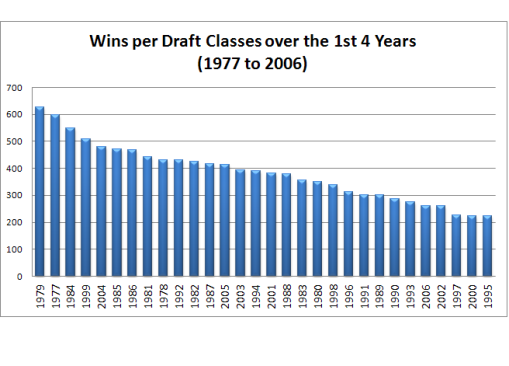
Nope, I think I'm going to have to pull a Bill Walton again: Andrea Bargnani was a terrrrrrible first overall pick. In fact, the expectation to be productive magnifies his lack of production, and so Arturo ranks him the tenth worst pick - at any draft position - of the last 30 years.
Let me let reiterate: the choice to select Bargnani as the first overall pick was worse than every other draft decision made in the last 30 years, with the exception of the drafting of the following players:
- Maurice Taylor
- Lancaster Gordon
- Tom Hammonds
- Mahmoud Abdul-Rauf
- Doug Smith (no, not that Doug Smith)
- Brad Sellers
- Joe Wolf
- Dajuan Wagner
- Nikoloz Tskitishvili
- Adam Morrison
"Bargnani has a single valuable skill"
Basketball is about scoring more points than the other team, something I've written about before (and you should probably read that if you haven't already). In order to win, you have to be good at both scoring and preventing your opponent from scoring. Andrea is not good at preventing others from scoring; he doesn't rebound well, pass the ball well, or steal well, and is around average when it comes to getting blocks. He doesn't turn the ball over. His defense is below average; he's improved over the years and isn't as bad as he used to be, but no one is going to mistake him for Dwight Howard. The one advantage Bargnani has over other bigs is his shooting, as he is above average with regards to Adj.FG%, FT%, FG attempts, and points scored.
The problem is that Bargnani's "unique and valuable skill" of perimeter shooting...isn't all that valuable. If you want to score points, there are two areas on the court you should be shooting from: 1) the immediate basket area and 2) the three-point line. All those deep twos and midrange shots? Inefficient. That's because the farther you get from the basket, the harder is is to make your shots, and the lower your percentages get. The reason why three-point shots are useful is because of the extra point. If you are shooting from somewhere other than the immediate basket area, it should be from the three-point line.
How have Bargnani's shot attempts changed over the years?
As you can see, shot attempts increased everywhere on the court, except for 3pt shots. The shots that increased the most were <10ft and 16-23ft shots (also of note: his percentages for shots other than threes and layups were abnormally high. I expect that, while part of the increase may be due to true improvement, most of it was due to random luck). He takes deep twos at almost the same rate that he takes threes; if you are going to be taking long-range shots, why not take a few steps back and go for the extra point? So, while Bargnani is a good shooter, he'd be even better if he started taking more threes and driving to the basket more often, and cut back on the other types of shots as much as possible.
And I think that's the reason why deep-shooting big men are so rare: big men are the tallest players on the court, and as such, are able to park themselves right next to the basket and score a bunch of easy points. A big man who doesn't do this is wasting his key talent - being tall. The big guys on your team must be able to rebound and get easy points next to the basket and Andrea doesn't do either of those things. Until he learns how to do those things, he will forever be an inefficient, unproductive player.
- Devin
- All basic NBA stats, including play time, salary, and age, are from Basketball-Reference
- Shooting data by location are from Hoopdata
- The Wins Produced (WP and WP48) metric is the work of Berri and Schmidt. I use the Automated Wins Produced site, which is powered by data from Basketball-Reference and Yahoo Sports and put together by Andres Alvarez.
- Positional averages (for PPS, etc) are from The Wages of Wins.
- All of the draft data is the work of Arturo Galletti
Subscribe to:
Posts (Atom)