Showing posts with label 2009-10 player review. Show all posts

Sunday, October 3, 2010

2009-10 Player Review: Reggie Evans


Tip o' the hat to Andres for essentially forcing me to include what I like to think of as a "statistical prologue" and a "statistical epilogue" (and...I largely "borrowed" them as well). So, from now on, I will include some variation of the following at the top of my posts (and another at the bottom):
This article may use several advanced stats. All of these are based on box score statistics that are adjusted for other factors including pace, position and team. A general scale is given for these, and links to advanced explanations are listed at the bottom of the page.
  • Wins Produced per 48 Minutes (WP48) – The number of wins a player produces in 48 minutes of play. 0.100 is average and 0.250 is considered the “superstar threshold”. A player a WP48 of 0.000 produces no wins, and any player with a negative WP48 produces a negative number a wins (or, if you prefer, a positive number of losses)

With that out of the way, as promised, here is the 2009-2010 player review for Reggie Evans:

Once upon a time, Evans was a very good player - he actually managed to produce at a level exceeding the "superstar threshold" (a WP48 in excess of 0.300) and spent several years above the "star threshold" (a WP48 in excess of 0.200) - but time stops for no one, and Evans' production and playing time has declined rapidly over the past couple of seasons. That being said, let's see how his production from last year compares with his previous three seasons, as well as the average PF:

I think the advanced stats show something quite clearly: Reggie Evans is not your normal NBA player. He does several things quite poorly, including take shots, making free-throws, getting blocks, assists, avoiding fouls, and avoiding turnovers. That would be enough to doom most players to a very unproductive career - but not Evans. Evans does one thing incredibly well: he rebounds like a madman. As a consequence, his free-throw attempts are also quite above average, because he often gets offensive rebounds close to the basket. As a bonus, he's also above average at getting steals, but it's really his rebounding that helps him out. If only he could shoot free-throws!
The major determinant of a good year for Evans revolves around shooting: is his PPS above or below average? Is his free throw shooting disgustingly terrible or merely atrocious? When Evans shoots well from the field, he posts star and superstar calibre WP48s. If he makes free-throws above the break-even point (47%), that's helpful as well. But both of these things have only happened about 50% of the time in the past four years.
Interestingly, Evans hasn't really shown any signs of age-related decline so far. Sure, his WP48 has declined as he's approached 30, but his rebounding, steals, and other athletic indicators haven't changed significantly. No, it appears that Evans' decline is related to his shooting. That being the case, I can't imagine that his WP48 will be any worse than last year's 0.129, and in fact, he may improve on that mark. The biggest problem is that he's not likely to get many minutes. He's also in the last year of his contract and may be traded - if he manages to find himself on a team that actually plays him, he'll get a chance to produce some wins.
 - Devin.
Stats used

Sunday, September 26, 2010

2009-10 Player Review: David Andersen

We've only got a few more player reviews left to do - and they're reviews of bench players who aren't likely to play very many minutes or contribute many wins next season. Up this time is David Andersen:


As you can see above, Andersen wasn't very successful in his one year stint with the Rockets, who wisely shipped him out to the Raptors for cash considerations and a future second round pick (the Rockets nailed Arturo's management principles on that one!). Why was Andersen so unproductive last year?


One big problem: he couldn't shoot. He was okay shooting at the rim (53.3%) and on 3s (AdjFG% 51.9%) but not so good anywhere else (41.8% <10ft, 46.4% 10-15ft, and 43.0% 16-23ft). The deep twos in particular are what hurt his shooting percentage the most. Even though his shot attempts and points scored were above average, those numbers were achieved inefficiently and so actually ended up hurting more than helping. His rebounding was below average, although not excessively so; same with his net possessions and fouls. His assists were actually above average and his blocks were pretty bad for a centre. Really, it would be better if Andersen played more power forward than centre (although he still wouldn't be all that productive), but with the Raptors desperate for size this year it's likely he'll be stuck at centre.

Tune in next post for a review of everyone's favourite ball-hog, Reggie Evans!

 - Devin.

Wednesday, September 8, 2010

2009-10 Player Review: Julian Wright

I've already posted a little bit about Julian Wright already, but let's take a more in-depth look this time:

Deja vu, man


Wright was something of a disappointment in New Orleans. He was one of those rare rookies who managed to be an above-average player in his first season, only to regress rather substantially for two straight seasons. Let's look for some clues as to how he lost productivity:


He started off shooting the ball very efficiently, breaking 1.10 PPS. He followed that up with seasons of 0.94 PPS and 1.01 PPS; with such volatile shooting efficiency, it's difficult to predict where he'll end up next year. There are some clear trends, though - Wright is a poor free throw shooter, a poor scorer, doesn't take many FG or FT attempts; is a below-average rebounder, possession-getter, blocker, and passer; and is above-average with respect to steals, TOs, and PFs. For Wright to improve next season, he should try to improve his rebounding and increase his shot attempts (while maintaining or improving on the efficiency level he showed last year).

While his overall progression does not look good, he is only 23 years old and I have him penciled in for a WP48 of 0.050 next season - right around his career mark. It is entirely possible that the change of scenery will do him good and he will return to the rate of production we saw from him as a rookie; then again, it's also entirely possible that his downward trend will continue and he will enter into negative WP48 territory. Based on Wright's career so far, neither would be exceptionally surprising.

 - Devin.

Saturday, September 4, 2010

2009-10 Player Review: Linas Kleiza

Let's take a look at the Raptors' international man of mystery, Linas Kleiza:

Well actually...this is more of a 2008-09 player review, but we'll pretend that it isn't.


Following the 2008-09 season, Kleiza played over in Europe for the Greek team Olympiakos. He was the leading scoring in the Euroleague (17.1 pts/game [a game is 40 minutes over there]) and as such won the Alphonso Ford Trophy. After the season ended he terminated his contract with Olympiakos and signed a 4-year, $20 million deal with the Raptors. Before going over to Europe, Kleiza played 4 seasons with the Nuggets - the last two of which he played at a near-average level. The following table includes his more specialized statistics for these last two NBA seasons as compared to the average SF and SG (the positions he mostly played) as well as - for fun - his Euroleague stats from last year, although please note that these numbers shouldn't be directly compared to NBA numbers.


The numbers show that Kleiza shoots with above-average efficiency, scores, rebounds, and gains possessions at an above-average level. Other than that, he is at or below average with respect to steals, blocks, assists, and fouls. As long as the Raptors don't try to play him as a PF, Kleiza should produce at a near-average to above-average level this year; as a 25 (soon to be 26) year-old, he should also continue to show some improvement. Based on past performance, I'm expecting a WP48 of at least 0.083, and he'll probably reach a WP48 of 0.100.

 - Devin.

Friday, September 3, 2010

2009-10 Player Review: Leandro Barbosa

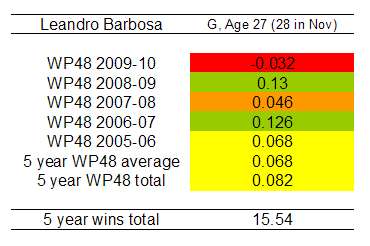
Let's let a look at the Brazilian Blur, Leandro Barbosa:


To say that last year was not a good year for the Brazilian would be an understatement; he went from a nice WP48 of 0.130 in 2008-2009 to a WP48 of -0.032 and only managed to play a career-low 44 games (and a career low 786 minutes played). Moreover, he continued his trend of alternating between good and bad years. Let's take a look at what changed over the past three seasons:


Barbosa gets most of his productivity from his scoring. It's not surprising, then, that when his shooting efficiency nosedived last year his productivity nosedived as well. His FG attempts were actually up, but his AdjFG% and FT attempts were down. Most of his other productivity mesasures were down and below-average (as they usually are for Barbosa).

Why did Barbosa's shooting efficiency suddenly drop off a cliff? Perhaps the answer lies in his shot selection:

Data provided by HoopData


Looking at these numbers, I notice a couple of things:
  1. Barbosa's percentages are down at every location on the court
  2. The percentage of his close-range shots (rim and <10ft) that were assisted last year increased
  3. The percentage of his mid-range and long-range shots (shots >10ft) that were assisted last year decreased
To me that suggests that Barbosa's shot selection was off last year (by off, I mean compared to his normal self). Out on the perimeter he tried to do it by himself too often, and then end result was a low-percentage shot. He had trouble getting closer to the basket by himself - likely due to injuries - and so most of his close-range shots were set-up by teammates. Of course, this is just a theory. An alternate theory is that he simply forgot how to shoot last year.

What's the outlook for this year? I've projected him to have a WP48 of 0.080, but if he has recovered from his injuries and maintains his pattern of alternating between bad and good seasons, he could improve on that mark. Then again, if he really has forgotten how to shoot, he could be significantly under that mark. Regardless, if he plays around 2000 minutes on the season, he will likely produce around 3 wins.

 - Devin.

Friday, August 27, 2010

2009-10 Player Review: Amir Johnson

Next on the list of players to be reviewed is Amir Johnson:


Johnson has an impressive history of past performance, albeit in relatively limited minutes (last season was the first in which he surpassed 1000 minutes played). Also of note, despite having already played for five seasons in the NBA, Johnson was the last player to be drafted directly out of high school and is only 23 years old. Given that he is so young and has been so productive in the past, I've projected him to have a WP48 of 0.200 next year. With Johnson, though, the question isn't about efficiency or productivity; the question is how many minutes he will play:


As you can see, several aspects of Johnson's game translate rather prominently to these statistics: he is a low-volume, high efficiency player, a poor free-throw shooter, an excellent rebounder, blocker, and possession-getter...and someone who fouls at a ridiculously high rate and has trouble staying on the court. However, if Amir fouls at the same 8.4PF/48min rate next season, he would still be able to play just over 34 minutes a game before he fouls out (if Jay Triano isn't afraid of foul trouble). And 34 minutes/game should be perfectly fine for the Raptors, who will be looking to get rookie Ed Davis some playing time. Playing Davis the remaining 14 minutes/game over the course of 82 games would give the rookie 1148 minutes for the season - enough to see what Davis has to offer.

 - Devin.

Wednesday, August 25, 2010

2009-10 Player Review: Jarrett Jack

For this 2009-10 player review, let's take a look at the player who is likely to be the Raptors starting PG going forward, Jarrett Jack:


While Jack has a history of solid production, last year was definitely a career year for him. Up until this past season, Jack had only had one above-average year (although admittedly he was very close in 2007-08). This means that, although his 5 year average WP48 and total WP48 look just about average, they have been skewed somewhat by last year's very good production. Going forward, it is possible that last year was somewhat of an outlier and that his WP48 will be closer to average (0.100) next year, but I'm going to be optimistic and hope that Jack has actually improved; I have projected a WP48 of 0.140 for Jack next year.

Here are Jack's specfic statistics from the past two seasons:


Looking at these two seasons side by side, at first glance it's rather remarkable that Jack's 09-10 season was more than twice as productive as his 08-09 season, given how similar most of the numbers were. Last season he saw small declines in rebounds, steals, net possessions, and blocks, and small increases in TOs and PFs (which decrease productivity), but greatly improved his shooting efficiency and assists. As long as Jack is able to maintain these increases (or to make up for any decreases by improving in other areas), Jack will be as productive next season.

 - Devin.

Sunday, August 22, 2010

2009-10 Player Review: Sonny Weems and DeMar DeRozan

For our next 2009-10 player review, as requested, let's take a look at the Young Gunz, Sonny Weems and DeMar DeRozan:


Weems doesn't have that much of a player history beyond what he did last year. In very limited minutes in Denver he was not very productive, but this past season he neared the production of anaverage player. At only 24 years old, it is likely that he will improve on last year's WP48, but we'll have to wait and see how much; I have conservatively projected him to reach a WP48 of 0.080 next season.


DeRozan's rookie season was rather underwhelming - he was about as close to producing 0 wins as Weems was to producing at an average level (so...not that good). But he is only 21 years old, and should improve next season to an even greater degree than Weems. I have projected DeRozan to reach a WP48 of 0.050, but young players can improve by leaps and bounds, so his improvement could be more pronounced. Then again, DeRozan wasn't that productive in college.

Here are the advanced stats:


Weems is clearly the better of the two; his shooting, points scored, rebounding, stealing, blocking, assisting, and fouling are better than DeRozan. DeRozan has the edge in FT attempts, TOs, and, consequently, a slight edge in net possessions. Neither player should be spending much time at SF, but DeRozan may be spending some time there this season.

For the Raptors to be putting so much hope into these two players is somewhat unsettling to me as a Raptor fan. Neither is likely to be producing at a "star" level (WP48 of 0.200) - let alone "superstar" level (WP48 of 0.300) - this upcoming season. Rather than retain these players (and, in the case of Weems, overpay to retain him next offseason) and hope for improvement from within, the Raptors should look to replace them with players who have a history of efficient production.

 - Devin.

Friday, August 20, 2010

2009-10 Player Review: Jose Calderon

For our second 2009-10 player review, let's heed Andres' (over at Nerdnumbers) request and take a look at Jose Calderon. Here is his summary table:


As you can see, Calderon has a history of good performance. The fact that Bryan Colangelo wants to get rid of him is puzzling to me. Yes, his production has decreased for three straight years, but injuries were partly to blame last year. In my projections for next season, I have Calderon performing at a WP48 of 0.210, which is somewhere between last year's 0.154 and the previous year's 0.245.

What changed for Calderon these last three years? Let's take a look at some more specific statistics from the past three seasons:

Wins for average PG calculated from a WP48 of 0.100 over a season of 1968 minutes


Calderon is still an efficient shooter, but he has been getting worse each of the past three years. His free throw percentage dropped from an all-time NBA record of 98.1% in 2008-2009 to a strangely average 79.8% this past year. Rebounds, steals, and assists were all down, and fouls were up (not a good thing). While his shooting efficiency is down, FG and FT attempts, as well as points, have been rising. It's almost as if Calderon has been neglecting to do all the things that made him an efficient player in favour of taking more shots - or maybe his injuries cost him some athleticism and forced him to take more jumpshots. Either way, here's hoping Calderon returns to form next season.

I'm also hoping Calderon will at least split the PG minutes with Jack this upcoming season, but I'm betting that he'll be traded either before the season starts or a few games into the season. If Calderon does get traded, it would be nice if he gets traded for someone who is productive (and not, say....Carmelo Anthony), but the Raptors (and Bryan Colangelo) haven't had the best track record lately when it comes to personnel moves.

 - Devin.

Sunday, August 15, 2010

2009-10 Player Review: Andrea Bargnani

For our first 2009-10 player review, let's take a look at Andrea Bargnani. Here is his summary table:


Bargnani's first two years were dreadful, particularly his 2007-08 season, when he produced -3.84 wins. He showed some signs of improvement during the 2008-09 season, but any progress was lost after this year. Charitably, I have predicted a WP48 of -0.010 for next season, but given his age (he's turning 25 in October) and past performance, the reality for next year could be even worse.

Why is Il Mago such an inefficient player? Let's compare him to an average PF and an average C, and throw in Troy Murphy as a comparison. Why Troy Murphy? Murphy is the player that Bargnani was supposed to be:

Average stats have been "borrowed" from The Wages of Wins. All stats are per 48min.


As you can see, Bargnani is actually above-average when it comes to shooting efficiency, FG attempts, points scored, TOs, and PFs. Where Bargnani falls short is FT attempts, assists, and especially net possessions (Reb + Stl - TO). To quote Bill Walton, Bargnani is a terrrrrrrible rebounder. He barely manages to out-rebound an average SF (7.6 Reb/48), despite the fact that he is 7ft tall. By contrast, Troy Murphy is an excellent rebounder (and a better shooter).

Bargnani is a 7ft tall player who plays PF and C. In order to improve his efficiency, he has to start rebounding like a PF or a C, because his numbers are compared to all the other PFs and Cs in the league, nearly all of whom are better rebounders. Rebounding adds possessions to a team; possessions are very valuable.

Next season, I'm penciling Bargnani in as the Raptors starting centre due to his height, size, and the fact that it is very likely he will be defending opposing teams' centres. Unless the Raptors trade or sign someone else, Bargnani will be the Raptors' centre. If that comes to pass, his WP48 and Wins Produced could be significantly worse than what I've included in my projections.

That concludes the first 2009-10 Player Review. I'll be taking requests for the next player review in the comments.

 - Devin.