New readers, please check out the basics before leaving any comments.
Last week I asked a question about players who were capable of getting triple-doubles. Today I want to ask a question based on a term that is often thrown around in sports: 'pound for pound'.
Back in the day, we used to hear about how Allen Iverson was, 'pound for pound', the "best scorer in the league" (of course, I beg to differ on that one). Frequently, boxers (the athletes, not the undergarments) are referred to as the best 'pound for pound' fighters. So, given my interest in basketball and the Toronto Raptors, what I want to know is, pound for pound, who are the most productive players in the history of the franchise?

Basketball analysis focusing on Canada's lone NBA team
Showing posts with label stats. Show all posts
Showing posts with label stats. Show all posts
Thursday, March 10, 2011


Saturday, March 5, 2011
The 50 greatest NBA players of all-time
New readers, please check out the basics before leaving any comments.
Given the team's record right now, Raptor news is a bit boring these days; eventually I will take another look at how the individual players have been playing, but Nerd Numbers is down (and the Game Splits tool - which I had just started to rely on for my weekly player evaluations - has been down for a while now). So today I will write about a topic that is barely even tangentially related to the Raptors - my version of the NBA's 50 greatest players.
Given the team's record right now, Raptor news is a bit boring these days; eventually I will take another look at how the individual players have been playing, but Nerd Numbers is down (and the Game Splits tool - which I had just started to rely on for my weekly player evaluations - has been down for a while now). So today I will write about a topic that is barely even tangentially related to the Raptors - my version of the NBA's 50 greatest players.
Friday, February 4, 2011
Champions and Drafted Players
New readers, please check out the basics before leaving any comments.
I've been away for a while, so I've been writing a bunch of new posts in the short term. Today I'd like to revisit a classic topic: NBA champions and the draft.
I've already shown that securing a top tree draft selection is generally not the ideal position to be in for an NBA team. To recap, I found that:
I've been away for a while, so I've been writing a bunch of new posts in the short term. Today I'd like to revisit a classic topic: NBA champions and the draft.
 |
| Congraturation! |
I've already shown that securing a top tree draft selection is generally not the ideal position to be in for an NBA team. To recap, I found that:
- in the lottery era (1985-present), 60% of teams that have ended up with a top three draft pick haven't made it past the first round of the NBA playoffs during their draftee's first four years in the league.
- to put it another way, only 40% of teams with a top three draft selection managed to advance past the first round in one or more of their draftees' first four years.
- during the lottery era - only four (Duncan, Robinson, Sean Elliott, who was traded away and then reacquired, and Darko Milicic, who shouldn't count because he didn't really play) out of the 78 players (5%) taken with a top three pick have won a championship with the team that drafted them.
- all that makes sense, as top three draft picks generally start their careers on bad teams. The Spurs lucked out with Duncan because, rather than being a bad team, they were a good team that had injury problems. The Pistons "lucked out" with Milicic because the Grizzlies were dumb enough to trade away their 2003 1st round pick in exchange for Otis Thorpe. Robinson and Elliott won their championships well after they were drafted, and Elliott was actually traded away and reacquired before he got his.
- top three picks fared a little bit better in the pre-lottery era - ten players (Jordan, Olajuwon, Worthy, Thomas, McHale, Magic, Walton, Kareem, Unseld, and Cazzie Russell) out of the 57 top three draftees (17.5%) eventually won with the team that drafted them, and only 28% of teams couldn't make it past the first round in their draftee's first four years.
- this also makes sense, as there were fewer teams in the pre-lottery days, which gave each team a better chance of moving up in the standings.
Wednesday, February 2, 2011
Week 14 Team Opponent Stats
New readers, please read the basics before leaving any comments.
Yesterday I posted the Team Stats update for week 14, and the day before that I posted the player stats for week 14. Today I'd like to post something I haven't done before: opponent stats. I figure that it would be interesting (and useful) to see how well other teams perform against the Raptors. Here's another of those weird double-scrolling charts:
Yesterday I posted the Team Stats update for week 14, and the day before that I posted the player stats for week 14. Today I'd like to post something I haven't done before: opponent stats. I figure that it would be interesting (and useful) to see how well other teams perform against the Raptors. Here's another of those weird double-scrolling charts:
Tuesday, February 1, 2011
Week 14 Team Stats Update
New readers, please check out the basics before you leave any comments.
Surprised? I said I'd be back again soon!
Yesterday I posted the individual Wins Produced for week 14, and as I mentioned, the numbers aren't pretty. But what about the team numbers? With those, perhaps we'll be able to put together some theories as to why the Raptors aren't playing well? Well, it just so happens that I have everything up and ready to go. Here's a nice - albeit somewhat strange, what with the double scrolling thing going on - sortable table of every team in the league:
Here are my thoughts:
Surprised? I said I'd be back again soon!
Yesterday I posted the individual Wins Produced for week 14, and as I mentioned, the numbers aren't pretty. But what about the team numbers? With those, perhaps we'll be able to put together some theories as to why the Raptors aren't playing well? Well, it just so happens that I have everything up and ready to go. Here's a nice - albeit somewhat strange, what with the double scrolling thing going on - sortable table of every team in the league:
Here are my thoughts:
- The end of the 3PT streak wasn't really surprising - the team still can't shoot threes. The team is dead last in 3P%, as well as second last in 3PA/FGA, which measures a team's tendency to take threes. That isn't all bad - that means that the team is somewhat aware of its lack of ability and at least limits the number of wasted possessions. Unfortunately, it also means that opponents can sag off perimeter players and clog up the paint, making closer shots more difficult.
- The Raptors are 16th in AdjFG% (adjusted FG%), at 49.27%. The league average is 49.66%, so while the Raps are a little behind in this department, they don't fare terribly here.
- When we account for free-throw shooting and look at TS%, the Raptors fall a few spots to 19th, at 53.20%. League average is 54.04%. This is because the Raps don't shoot that many (FT/48 and FTa/FGa are low) and they shoot them poorly (74.15% compared to a league average of 76.15%).
- The Raptors are 22nd in net possessions (REB+STL-TO), at 6.7/48mins. The league average is 7.0, so again, the Raps aren't doing too badly here.
- The big problem is that Toronto is below average in both TS% and net possessions. While there are some good teams that can't shoot (Portland, Memphis, Chicago, and Philadelphia), these teams make up for it by being able to secure extra possessions. Likewise, the good teams that can't secure extra possessions (Phoenix, Boston, and Atlanta) make up for it by being above average at shooting. The teams that are below average in both of these statistics (Cleveland, Toronto, Washington, New Jersey, Detroit, Charlotte, and the improving Clippers) are just...bad.
- There are three additional "helping" stats that can slightly improve performance: assists, blocks, and fouls. The Raptors are 12th in assists, 27th in blocks, and are 8th in fouls committed. The helping stats aren't really helpful, are they?
The trade deadline is coming up in about three more weeks - will the team make any moves to shore up its weaknesses? Will I stop posing rhetorical questions in my future posts? Keep tuning in to find out.
- Devin
Thursday, December 16, 2010
Week 7 Raptors Auto WP
New readers, please read the basics before leaving any comments.
Time for week 7 WP numbers, which are Powered by Nerd Numbers (full spreadsheet here):
Here are my thoughts:
- Devin.
Time for week 7 WP numbers, which are Powered by Nerd Numbers (full spreadsheet here):
Here are my thoughts:
- Bargnani, Kleiza, and Barbosa have all had good games over the past week or so, and it's now showing in their WP48. Bargnani is up almost 0.035, Kleiza's up 0.040, and Barbosa's up around 0.040. Despite what many people think, I would love to see these trends continue.
- Those three are still really unhelpful: only Barbosa is in the positive range (WP48 0.004), and only barely.
- Weems and DeRozan remain mostly unchanged, and continue to offer very little as well.
- Julian Wright has improved slightly.
- Calderon and Evans haven't played, and so have remained stable.
- Everyone else - Johnson, Bayless, Dorsey, and Davis - has declined. Other than Johnson, these players haven't played that many minutes, so the variation is not surprising. Johnson's been up and down all season long.
- Even though his WP48 decreased, Bayless improved his AdjFG% by 5%. So why did his WP48 decrease? More minutes at PG (due to Calderon being injured) and fewer net possessions (his rebounding had been exceptional and was bound to regress).
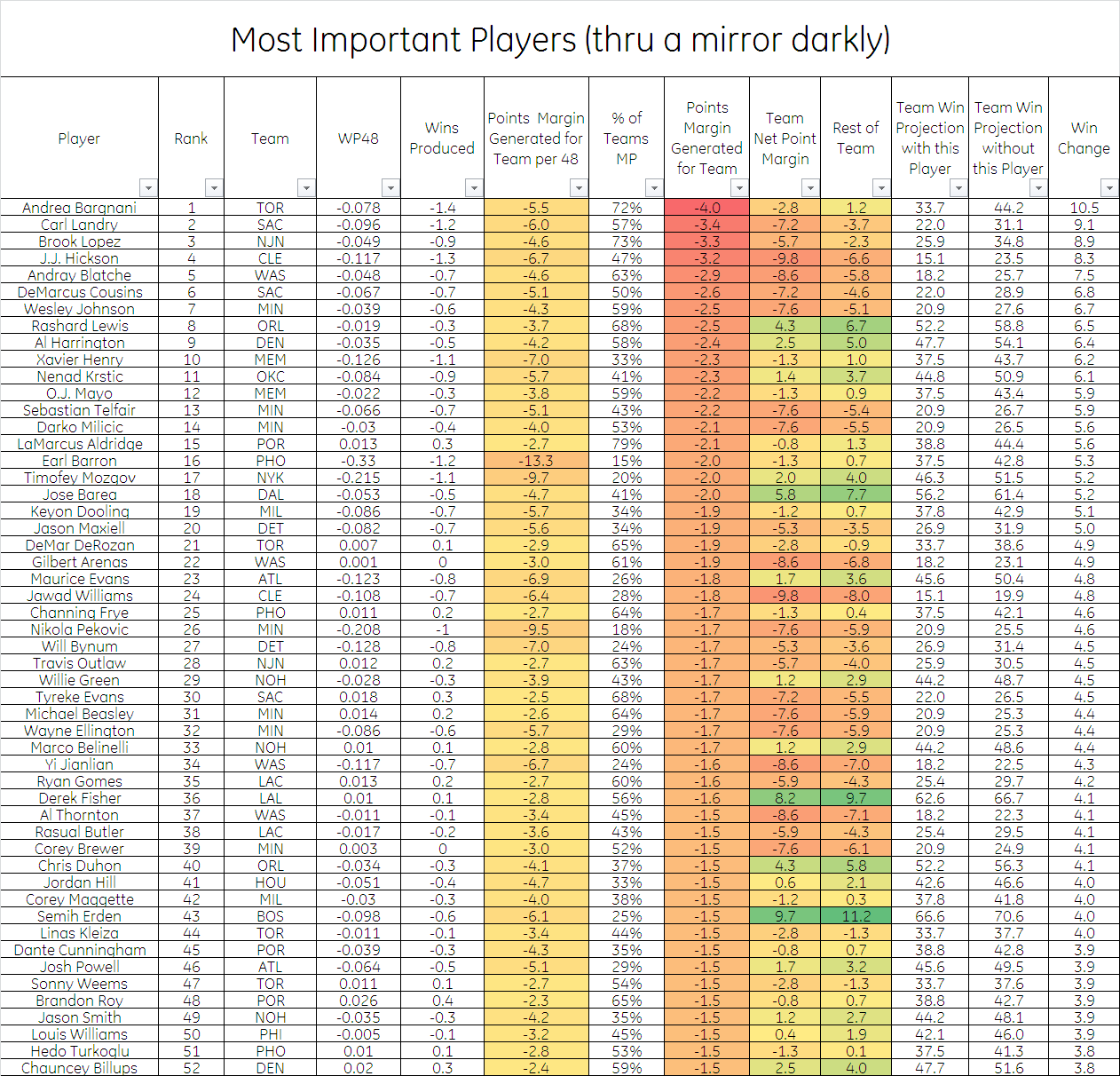
- Reggie Evans and Amir Johnson are 27th and 37th, respectively, on Arturo's list of most important players
- Bargnani, DeRozan, Kleiza, and Weems (1st, 21st, 44th, and 47th, respectively) are on Arturo's naughty list.
- Maybe we'll just kick Barbosa out of that group for the time being and stick with the four horsemen again.
- Devin.
Sunday, December 12, 2010
Week 6/7 Team Stats
New readers, please check out the basics before leaving any comments.
Time for a team stats update! These numbers are provided by dougstats and Nerd Numbers (full spreadsheet here):
Here are some thoughts:
- Devin
Time for a team stats update! These numbers are provided by dougstats and Nerd Numbers (full spreadsheet here):
Here are some thoughts:
- Toronto's fallen a few places - down from 20th to 22nd place - in terms of team WP48. As before, there is a log-jam - now narrowed to 18th-22nd place - so don't don't read too much into it.
- The 3pt shooting is slowly getting better, from around 31% to almost 34%. 3pt attempts have also increased slightly. Team shooting in general is doing a bit better.
- Last time the surprises were the Hornets, the Pacers, the Nets, and the Kings. This is how they are doing now: Hornets (league 9th, West 5th); Pacers (league 8th, East 4th); Nets (league 23rd, East 12th); and Kings (league 25th, West 13th). The Trailblazers (league 15th, West 8th) are doing a bit better, but the Warriors (league 28th, West 15th) are really stinking it up.
- The Cavs (league 29th, East 14th) are also not playing well at all.
- Meanwhile the Spurs (league 1st, West 1st) have ascended to the top spot, ahead of the other front-runners (Heat, Celtics, and Lakers).
- Devin
Wednesday, December 8, 2010
Bargnani is playing better this season...right?
New readers, please read the basics before leaving any comments on this post.
Ah, another Barngani post. Whenever I feel like this site hasn't been getting much traffic lately, I know I can always count on a good ol' Bargnani post to bolster the numbers.
Last time I pointed out that not only should Bargnani not be considered an all-star this season, but that he shouldn't even be on the all-star ballot. Predictably, there were several negative and insulting comments left on that post, but thankfully, there were also some thoughtful comments, including this one by Eugene:
First let's look at Bargnani's numbers for the season. In the following table I've compared the stats of each of Bargnani's seasons, his career stats, and his career stats before this season, to the average numbers posted by the average centre and the average power forward (and no, we are not getting into another debate about which position Bargnani plays; he is clearly a PF who spends at least some time playing C). In addition to the things I normally look at, I've also included PER (which I do not endorse, because it rewards players for taking addtional shots, even when those shots miss), Win Shares per 48 (which I do not endorse, although it is much better than PER), and PPG. Here's the table:
What do the numbers say? Of the three comprehensive stats - WP48, WS/48, and PER, all of them say that Bargnani is less productive this season as compared to last season. Let me repeat: all three say that Bargnani is playing worse this season.
So what's changed? While he must be congratulated for getting to the line more often this year (2.5 more FTA per 48 minutes over last year - quite an achievement), making a higher percentage of his free-throws, and incrementally increasing his assists and steals (which remain close to his career averages and continue to be below average), his shooting efficiency has taken a dive, his turnovers have nearly doubled, and his already paltry rebounding numbers have fallen. His usually decent block numbers have decreased quite a bit, and his fouls - while still better than average - have increased.
Hmmm...am I forgetting to mention something? Oh yes: PTS, and PPG. Both have increased substantially. Unfortunately, given that Bargnani's shooting efficiency has decreased this year, he requires more shot attempts to get those points, and each missed shot hurts the team. Sure, he's making more shots and scoring more points, but all those additional missed shots fall into the hands of the opposing teams, which use the extra possessions to score more of their own points. Right now, Bargnani's shooting efficiency is just barely above the average numbers for power forwards and centres, and coming from a guy for whom shooting is supposed to be a strength, that's not a good sign.
Bargnani is a "scorer" who doesn't score very efficiently, one who also falls short in almost every other area of the game. Although his rebounding is particularly poor this year, he has always been a poor rebounder. Rather than hypothesizing that Evans (and Bosh before him) are "stealing his rebounds", perhaps the simpler explanation - that Bargnani simply can't or won't rebound - is the best one? After he's had a few more games without Evans, I'll take a look at his rebounds before and after Evans went down with injury, and I suspect that there will be little difference between the numbers.
After all, with Evans out, all that means is that someone else will be "stealing" rebounds away from him, right? Eventually, one must accept that Bargnani is simply a terrible, terrible rebounder.
Finally, let me address the following anonymous comment:
It has been shown that, time and time again, fans, coaches, and most members of the media use scoring to determine awards - no question about that. We also know that certain big-name players - Jordan (Wizards-era), Shaq (post Lakers), Vince Carter (most of the time), Yao Ming (while injured), and others - get voted in all the time, even when they don't deserve it. We also always hear arguments about how "entertaining", "exciting", and "fun" some players are to watch, and how that makes them qualify for the all-star game. Here's a shocking idea: how about the most productive players in the league make the all-star game?
Furthermore, do we really need to create all-star ballots in the first place? How many people actually fill out the physical ballots at arenas? I'm certain that most of the balloting happens online. Why not open up the online ballot to every single player in the league, removing the need to write players in? When using an online ballot, it's not like the NBA has to worry about printing costs and must keep the list of players short.
The team stats for week six will be up in a couple of days - I'm having computer problems at the moment. Also in store over the next little bit is the Raptors' all-time wins produced leaders, analysis that will be Powered by Nerd Numbers.
- Devin
Ah, another Barngani post. Whenever I feel like this site hasn't been getting much traffic lately, I know I can always count on a good ol' Bargnani post to bolster the numbers.
Last time I pointed out that not only should Bargnani not be considered an all-star this season, but that he shouldn't even be on the all-star ballot. Predictably, there were several negative and insulting comments left on that post, but thankfully, there were also some thoughtful comments, including this one by Eugene:
The more I look at bargnani's play this year and look at the relevant stats, the more I have come to a conclusion that is opposite to what has been generally suggested on this blog. That is to say: it is not the case that wp48 numbers show that, contrary to naive opinion, bargnani is an astonishingly bad NBA player. Rather, the fact that bargnani is a reasonably decent NBA player shows that there is something very seriously wrong with wins produced.
This is especially made clear when you look at the raptors front court tandem from earlier in the year. Bargs and Evans played a lot of minutes together, and according to wp48 bargs was mind-shatteringly awful while, simultaneously, evnas was the 4th best player in the NBA. What this demonstrates to me is that wp48 does a very bad job of allocating credit for wins. If you average their wp48 numbers, the average value makes sense, but wp48 gives Evans an unreasonable amount of credit and bargnani an unfair share of blame.Eugene: that was a constructive comment - thanks for leaving it. But it's a common criticsm that us WP writers hear all the time; Arturo of Arturo's Silly Stats has written a bunch of stuff on it lately. Rather than examine WP methodology - I'll leave that Arturo - let's take a look at Bargnani's year-by-year numbers. If the numbers show that Bargnani has significantly improved his playing this year, that might be an indication that WP may have flaws. And if the numbers show that Bargnani has become more productive with Evans out, that might also be a sign that WP is flawed.
First let's look at Bargnani's numbers for the season. In the following table I've compared the stats of each of Bargnani's seasons, his career stats, and his career stats before this season, to the average numbers posted by the average centre and the average power forward (and no, we are not getting into another debate about which position Bargnani plays; he is clearly a PF who spends at least some time playing C). In addition to the things I normally look at, I've also included PER (which I do not endorse, because it rewards players for taking addtional shots, even when those shots miss), Win Shares per 48 (which I do not endorse, although it is much better than PER), and PPG. Here's the table:
What do the numbers say? Of the three comprehensive stats - WP48, WS/48, and PER, all of them say that Bargnani is less productive this season as compared to last season. Let me repeat: all three say that Bargnani is playing worse this season.
So what's changed? While he must be congratulated for getting to the line more often this year (2.5 more FTA per 48 minutes over last year - quite an achievement), making a higher percentage of his free-throws, and incrementally increasing his assists and steals (which remain close to his career averages and continue to be below average), his shooting efficiency has taken a dive, his turnovers have nearly doubled, and his already paltry rebounding numbers have fallen. His usually decent block numbers have decreased quite a bit, and his fouls - while still better than average - have increased.
Hmmm...am I forgetting to mention something? Oh yes: PTS, and PPG. Both have increased substantially. Unfortunately, given that Bargnani's shooting efficiency has decreased this year, he requires more shot attempts to get those points, and each missed shot hurts the team. Sure, he's making more shots and scoring more points, but all those additional missed shots fall into the hands of the opposing teams, which use the extra possessions to score more of their own points. Right now, Bargnani's shooting efficiency is just barely above the average numbers for power forwards and centres, and coming from a guy for whom shooting is supposed to be a strength, that's not a good sign.
Bargnani is a "scorer" who doesn't score very efficiently, one who also falls short in almost every other area of the game. Although his rebounding is particularly poor this year, he has always been a poor rebounder. Rather than hypothesizing that Evans (and Bosh before him) are "stealing his rebounds", perhaps the simpler explanation - that Bargnani simply can't or won't rebound - is the best one? After he's had a few more games without Evans, I'll take a look at his rebounds before and after Evans went down with injury, and I suspect that there will be little difference between the numbers.
After all, with Evans out, all that means is that someone else will be "stealing" rebounds away from him, right? Eventually, one must accept that Bargnani is simply a terrible, terrible rebounder.
Finally, let me address the following anonymous comment:
Wins Produced and defensive capabilities have absolutely nothing to do with making the all-star games. The majority of fans will never vote based on that, and I guarantee Coaches don't break down WP numbers to make decisions in their voting.
It all comes down to who they 'feel' deserves it (although from my experience name recognition tends to be paramount). While more hardcore fans will base decisions on advanced numbers, don't expect an all-star game, that is for fun and completely irrelevant, to be based on that.
If he does make the all-star game (and I'm not saying he will) it will be completely based on his scoring.
I'm also going to laugh my ass off if shaq gets voted to the all-star game by either the fans or coaches.While it is true that the majority of fans do not take defensive capabilities (and certainly WP) into account when they are filling out their all-star ballots, that doesn't make it right. I think it would be better if fans learned to recognize more productive players and rewarded them accordingly. Of course, certain defensive players - like four-time all-star Ben Wallace - do manage to make get fan recognition, so the argument that fans completely ignore defensive is not quite accurate.
It has been shown that, time and time again, fans, coaches, and most members of the media use scoring to determine awards - no question about that. We also know that certain big-name players - Jordan (Wizards-era), Shaq (post Lakers), Vince Carter (most of the time), Yao Ming (while injured), and others - get voted in all the time, even when they don't deserve it. We also always hear arguments about how "entertaining", "exciting", and "fun" some players are to watch, and how that makes them qualify for the all-star game. Here's a shocking idea: how about the most productive players in the league make the all-star game?
Furthermore, do we really need to create all-star ballots in the first place? How many people actually fill out the physical ballots at arenas? I'm certain that most of the balloting happens online. Why not open up the online ballot to every single player in the league, removing the need to write players in? When using an online ballot, it's not like the NBA has to worry about printing costs and must keep the list of players short.
The team stats for week six will be up in a couple of days - I'm having computer problems at the moment. Also in store over the next little bit is the Raptors' all-time wins produced leaders, analysis that will be Powered by Nerd Numbers.
- Devin
Wednesday, December 1, 2010
Week 5 WP numbers
New readers, please check out the basics before leaving any comments.
After almost a week travelling to and fro, I'm back and ready to post the Week 5 auto WP numbers. A lot of important things have happened, especially Reggie Evans going down with a broken foot and the imminent return of Ed Davis. Here are the numbers (spreadsheet here):
Here are my thoughts:
And how was Bargnavans doing?
Pretty well, actually. With Evans out, who will the Raptors pair up with Bargnani, and will they make up for his flaws? Only time will tell; tune in next week to find out!
Or, you know, watch the games. But if you come here, you won't even have to!
- Devin
After almost a week travelling to and fro, I'm back and ready to post the Week 5 auto WP numbers. A lot of important things have happened, especially Reggie Evans going down with a broken foot and the imminent return of Ed Davis. Here are the numbers (spreadsheet here):
Here are my thoughts:
- Reggie. The player with the third highest WP48 in the league (minimum 100 MP) was the driving force behind the relatively surprising Raptors. Now that he's out for 4-6 weeks with a broken foot, the team is going to have to find a way to replace his productivity (which was mainly due to rebounding).
- Could that player be Joey Dorsey? I've said it over and over - when Dorsey gets playing time, he produces at a very high level. He started in Evans' place the other day and replaced him quite nicely. Surprisingly, Dorsey's rebounding is very similar to Reggie's. The only problem he might face is foul-trouble and a lack of minutes.
- With Jack gone, Calderon has picked it up quite a bit. Perhaps the Hornets trade has lead to some psychological gains in his case. He's really only improved with regards to shooting, something I've been waiting for, so it's not unexpected.
- Bayless and Stojakovic have been quite good in limited minutes (and Jack has been terrible - with a WP48 of -0.159 in 70 min - over in New Orleans). But it's too early to fully evaluate stats just yet, so no one jump on me just yet. Bayless still can't shoot, but so far he's been getting to the line like crazy.
- Bargnani still "leads" the league with -1.5 wins, and his closest competitor is Knicks centre Tomofey Mozgov at -0.9 wins. Barring injury, I think Bargs is a lock to win the fewest wins produced this year.
- Bargnani is shooting less accurately, but a decrease in FGA and an increase in FTA has helped to offset that. Overall, he is playing slightly better than he was last time.
- Kleiza has gotten a little bit better across the board, and it's showing in his numbers. Mind you, he's still been terrible so far this year, but he's improving.
- Sonny Weems has gotten quite a bit worse. His FGA have stayed about the same, but his FTA have decreased and his PPS and AdjFG% have dropped quite a bit (from 1.11 to 0.98 and 55.7% to 49.1%, respectively).
And how was Bargnavans doing?
Pretty well, actually. With Evans out, who will the Raptors pair up with Bargnani, and will they make up for his flaws? Only time will tell; tune in next week to find out!
Or, you know, watch the games. But if you come here, you won't even have to!
- Devin
Sunday, November 21, 2010
Team Stats Update
New readers, please check out the basics before leaving any comments.
Here are the updated team stats (current as of 11/20/10) (full spreadsheet here):
Raptors have moved up quite a bit (and this doesn't even include the victory over the Celtics earlier today). Last time I took a look at this, the Raps were ranked 25th in the league in WP48 and 12th in the East; now they are ranked 20th in the league and 10th in the East. There's a bit of a log-jam from 18th-24th though, so don't read too much into it yet. The story remains largely the same; the Raptors still can't shoot, especially three-pointers. Perhaps the Raptors actually intend to use Peja to boost their production for the three-point line?
Right now, the surprises for me are the Hornets (league 5th, West 3rd), the Pacers (league 10th, East 6th), the Nets (league 23rd, East 11th), and the Kings (league 25th, West 13th). The Warriors and Trailblazers haven't really lived up to my expectations either, but they have dealt with relatively unexpected injuries (Oden was expected; Roy, not so much).
- Devin
Here are the updated team stats (current as of 11/20/10) (full spreadsheet here):
Raptors have moved up quite a bit (and this doesn't even include the victory over the Celtics earlier today). Last time I took a look at this, the Raps were ranked 25th in the league in WP48 and 12th in the East; now they are ranked 20th in the league and 10th in the East. There's a bit of a log-jam from 18th-24th though, so don't read too much into it yet. The story remains largely the same; the Raptors still can't shoot, especially three-pointers. Perhaps the Raptors actually intend to use Peja to boost their production for the three-point line?
Right now, the surprises for me are the Hornets (league 5th, West 3rd), the Pacers (league 10th, East 6th), the Nets (league 23rd, East 11th), and the Kings (league 25th, West 13th). The Warriors and Trailblazers haven't really lived up to my expectations either, but they have dealt with relatively unexpected injuries (Oden was expected; Roy, not so much).
- Devin
Wednesday, October 20, 2010
World Statistics Day
Today is the first World Statistics Day, a day to "raise awareness of the many achievements of officials statistics premised on the core values of service, professionalism, and integrity."
This finally gives me the opportunity to bring something up: the cancellation of the Canadian Long-Form Census.
Now the purpose of this blog is not to talk about politics - this is a site devoted to covering the NBA's Toronto Raptors and other basketball related issues. However, I will make an exception in this case, because I have to believe that statistical validity knows no political bounds (although unfortunately, that might not be true). The official statistics gathered by the Canadian census are far more important than the statistics that I and other Wages of Wins network writers rely on to produce the content of our blogs, but they remain statistics, and it is important that everyone - especially government - understands how statistics work.
Replacing a mandatory census with a voluntary one introduces sample bias to the data. Sending out more forms and getting more responses from a voluntary census will not correct this error; once the survey is made voluntary, certain populations of Canadians will be under-represented. Dozens of organizations across the country have voiced their objections to the changes to the census based exactly on these grounds, but the Canadian government shows no signs of reversing the decision. Even worse: the voluntary census will be more costly than the old census.
With that - if anyone is still reading this - I leave you with two video links (I don't want to embed them):
In the next few days I will be posting the following: preseason review 4 (of 4), 2010-11 NBA predictions, and (thanks to reader TotalFuckwad) an evaluation/discussion of Raptors management.
- Devin
This finally gives me the opportunity to bring something up: the cancellation of the Canadian Long-Form Census.
Now the purpose of this blog is not to talk about politics - this is a site devoted to covering the NBA's Toronto Raptors and other basketball related issues. However, I will make an exception in this case, because I have to believe that statistical validity knows no political bounds (although unfortunately, that might not be true). The official statistics gathered by the Canadian census are far more important than the statistics that I and other Wages of Wins network writers rely on to produce the content of our blogs, but they remain statistics, and it is important that everyone - especially government - understands how statistics work.
Replacing a mandatory census with a voluntary one introduces sample bias to the data. Sending out more forms and getting more responses from a voluntary census will not correct this error; once the survey is made voluntary, certain populations of Canadians will be under-represented. Dozens of organizations across the country have voiced their objections to the changes to the census based exactly on these grounds, but the Canadian government shows no signs of reversing the decision. Even worse: the voluntary census will be more costly than the old census.
With that - if anyone is still reading this - I leave you with two video links (I don't want to embed them):
- Canadians: Funeral for the Long-Form Census
- Americans: Elect the Willfully Ignorant!
- Everyone else: sorry, nothing special for you, but you have my permission to watch both!
In the next few days I will be posting the following: preseason review 4 (of 4), 2010-11 NBA predictions, and (thanks to reader TotalFuckwad) an evaluation/discussion of Raptors management.
- Devin
Friday, October 1, 2010
Wins Produced and Statistical "Skepticism"
Because I'm stuck using a Mac for the time being, at the moment I have no idea how to make the nice images I like to include in my posts; in an effort to produce some meaningful content, I'm going to do a general post on Wins Produced and productivity in basketball.
Wins Produced (WP) is the best metric for evaluating NBA players. Don't just take my word for it; read all of these articles. But there will always be "skeptics", who, when presented with statistical evidence, proven predictive power, and the background theory behind WP, just can't let go of their "gut" feelings.
With that in mind, I'm going to try to explain the rationale behind WP. David Berri, Arturo Galletti, Andres Alvarez, and others in the Wages of Wins network have largely appealed to the reality-based community and relied on statistical arguments in favour of WP; I'm going to forgo the numbers and deal mostly with words.
How to win in basketball
How do you win a basketball game? It seems obvious: all you have to do is score more than your opponent. That means that doing things that get you points are helpful, as are doing things that prevent your opponent from scoring. Things that you do that do not lead to points are not helpful, as are things that lead to your opponent scoring points. So here are the four major categories of actions in a basketball game:
Now that we have that settled, it should be pretty easy to figure out which on-court actions help your team win. Here are some of the on-court actions that clearly belong in the first major category, "actions that help your team score points":
Here are some of the on-court actions that clearly belong in the second major category, "actions that help your opponent score points":
Now for the on-court actions that belong in the third major category, "actions that prevent your opponent from scoring points". It's actually very hard to think of on-court actions that only belong in this category (if you can think of any more, leave me a comment):
Finally, the fourth major category, "actions that prevent your team from scoring points":
Now we get into the three derivative categories, which I find much more interesting. Let's go over the positive one first, "actions that both help your team score points and prevent your opponent from scoring points":
Now let's look at the negative derivative category, "actions that both help your opponent score points and prevent your team from scoring points":
Then we have the neutral derivative category, "actions that don't fall into any of the above six categories". This is another one that is hard to think up examples for:
To what degree?
Now that we know which actions do what, it's up to the stats experts to do analysis and come up with formulas that can determine to what degree each on-court action is responsible for winning. Unfortunately, some on-court actions - like quality of defence - are notoriously hard to determine. Stats experts have to rely on the only consistent and measurable on-court actions that exist for basketball - box score statistics. Yes, box score statistics can't measure all defensive contributions (remember, steals, turnovers, and blocks are all defensive measures that are a part of the standard box score), but they do measure some of the defensive contributions each player makes. So, using the standard box score stats, David Berri came up with Wins Produced (WP), which explains 95% of a team's wins. It's not perfect, no; but 95% is pretty damn good, and far more accurate than anything else out there. If you are interested in the methodology behind the specific way that WP determines productivity, I won't even try to give a detailed explanation - I'll just give you the links and let you have fun without me.
I hope that this post will help all you stats "skeptics" out there to reconsider your arguments. But, if that's not the case, I hope it was at least somewhat interesting.
- Devin.
Wins Produced (WP) is the best metric for evaluating NBA players. Don't just take my word for it; read all of these articles. But there will always be "skeptics", who, when presented with statistical evidence, proven predictive power, and the background theory behind WP, just can't let go of their "gut" feelings.
With that in mind, I'm going to try to explain the rationale behind WP. David Berri, Arturo Galletti, Andres Alvarez, and others in the Wages of Wins network have largely appealed to the reality-based community and relied on statistical arguments in favour of WP; I'm going to forgo the numbers and deal mostly with words.
How to win in basketball
How do you win a basketball game? It seems obvious: all you have to do is score more than your opponent. That means that doing things that get you points are helpful, as are doing things that prevent your opponent from scoring. Things that you do that do not lead to points are not helpful, as are things that lead to your opponent scoring points. So here are the four major categories of actions in a basketball game:
- Actions that help your team score points (positive outcome)
- Actions that help your opponent score points (negative outcome)
- Actions that prevent your opponent from scoring points (positive outcome)
- Actions that prevent your team from scoring points (negative outcome)
- Actions that both help your team score points and prevent your opponent from scoring points (double positive outcome)
- Actions that both help your opponent score points and prevent your team from scoring points (double negative outcome)
- Actions that don't fall into any of the above six categories (neutral outcome)
Now that we have that settled, it should be pretty easy to figure out which on-court actions help your team win. Here are some of the on-court actions that clearly belong in the first major category, "actions that help your team score points":
- Making a 2pt shot
- Making a 3pt shot
- Making a free-thow
- Getting an assist
Here are some of the on-court actions that clearly belong in the second major category, "actions that help your opponent score points":
- Letting an opponent score points (ie: playing terrible defence)
- Fouling an opponent (leads to free-throws)
- Getting a technical foul (leads to free-throws)
- Goaltending
- Scoring on your own basket
Now for the on-court actions that belong in the third major category, "actions that prevent your opponent from scoring points". It's actually very hard to think of on-court actions that only belong in this category (if you can think of any more, leave me a comment):
- Preventing an opponent from scoring (ie: playing good defence)
Finally, the fourth major category, "actions that prevent your team from scoring points":
- Missing a 2pt shot
- Missing a 3pt shot
- Missing a free-thow
Now we get into the three derivative categories, which I find much more interesting. Let's go over the positive one first, "actions that both help your team score points and prevent your opponent from scoring points":
- Grabbing an offensive rebound
- Grabbing a defensive rebound
- Stealing the ball from an opponent
- Forcing a turnover
- Drawing a charge
- Blocking the shot of an opponent
- Winning a jump-ball
Now let's look at the negative derivative category, "actions that both help your opponent score points and prevent your team from scoring points":
- Turning the ball over
- Getting an offensive foul
- Losing a jump-ball
- Allowing an opponent to get an offensive rebound
- Allowing an opponent to get a defensive rebound
Then we have the neutral derivative category, "actions that don't fall into any of the above six categories". This is another one that is hard to think up examples for:
- Winning an opening tip
- Losing an opening tip
To what degree?
Now that we know which actions do what, it's up to the stats experts to do analysis and come up with formulas that can determine to what degree each on-court action is responsible for winning. Unfortunately, some on-court actions - like quality of defence - are notoriously hard to determine. Stats experts have to rely on the only consistent and measurable on-court actions that exist for basketball - box score statistics. Yes, box score statistics can't measure all defensive contributions (remember, steals, turnovers, and blocks are all defensive measures that are a part of the standard box score), but they do measure some of the defensive contributions each player makes. So, using the standard box score stats, David Berri came up with Wins Produced (WP), which explains 95% of a team's wins. It's not perfect, no; but 95% is pretty damn good, and far more accurate than anything else out there. If you are interested in the methodology behind the specific way that WP determines productivity, I won't even try to give a detailed explanation - I'll just give you the links and let you have fun without me.
I hope that this post will help all you stats "skeptics" out there to reconsider your arguments. But, if that's not the case, I hope it was at least somewhat interesting.
- Devin.
Subscribe to:
Posts (Atom)